
Fan Dongwang - Painting Between Worlds
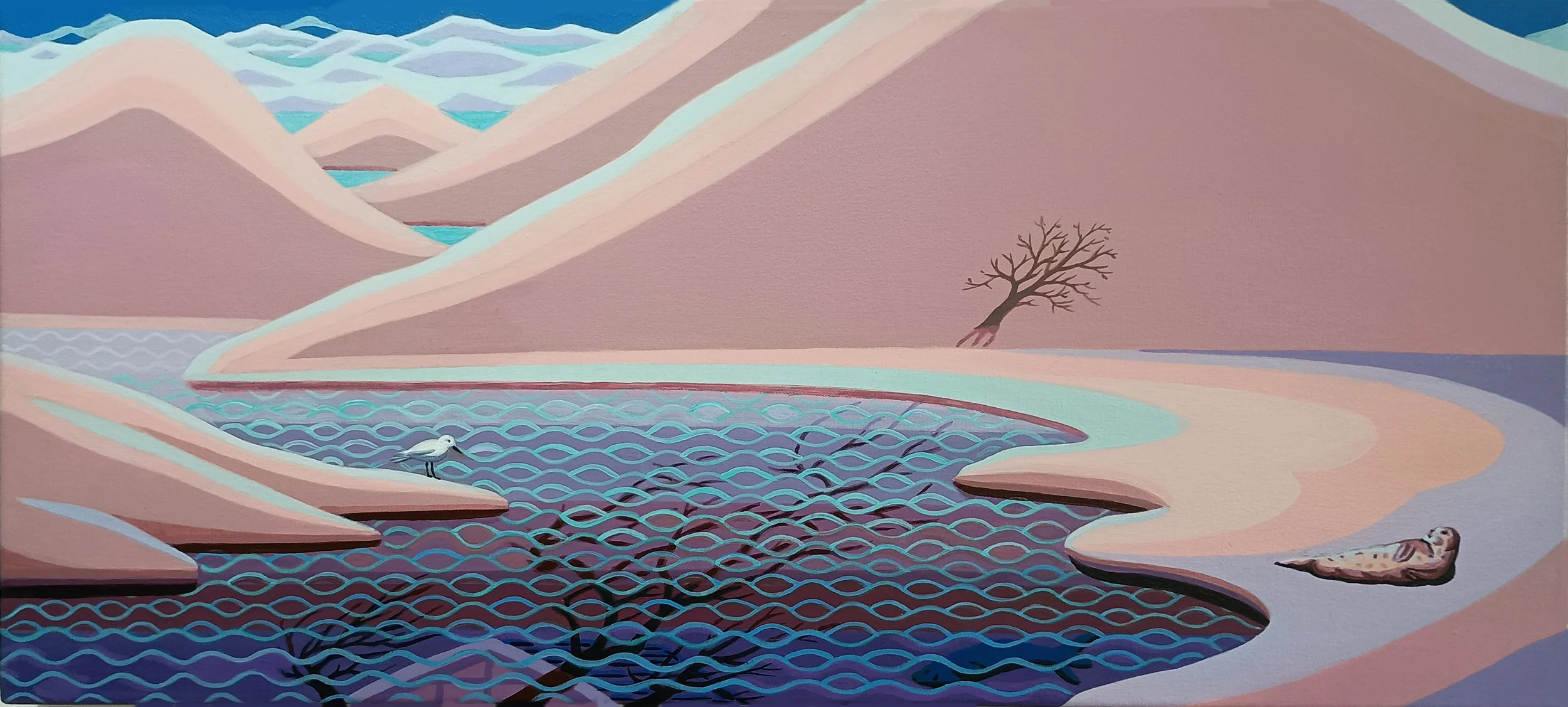
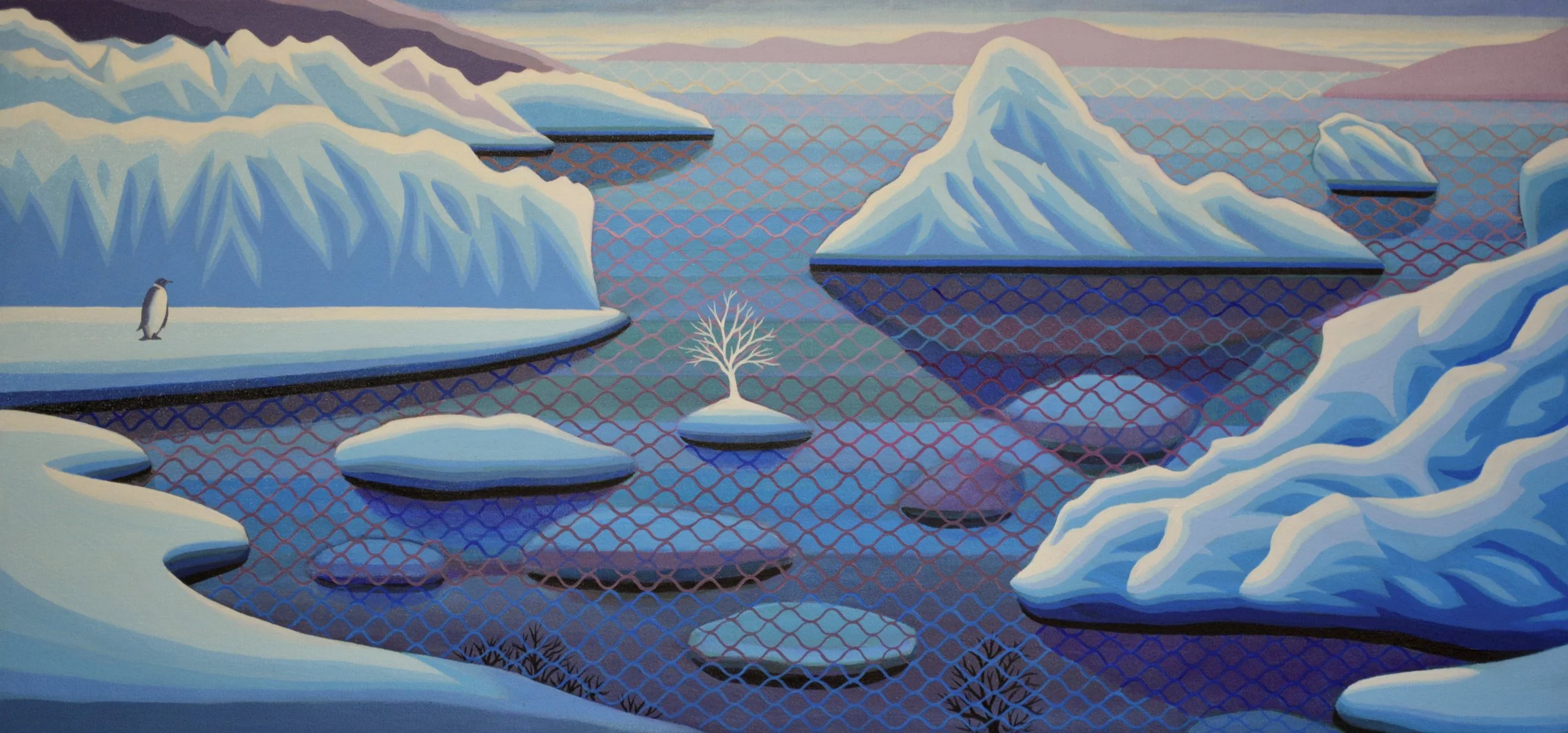
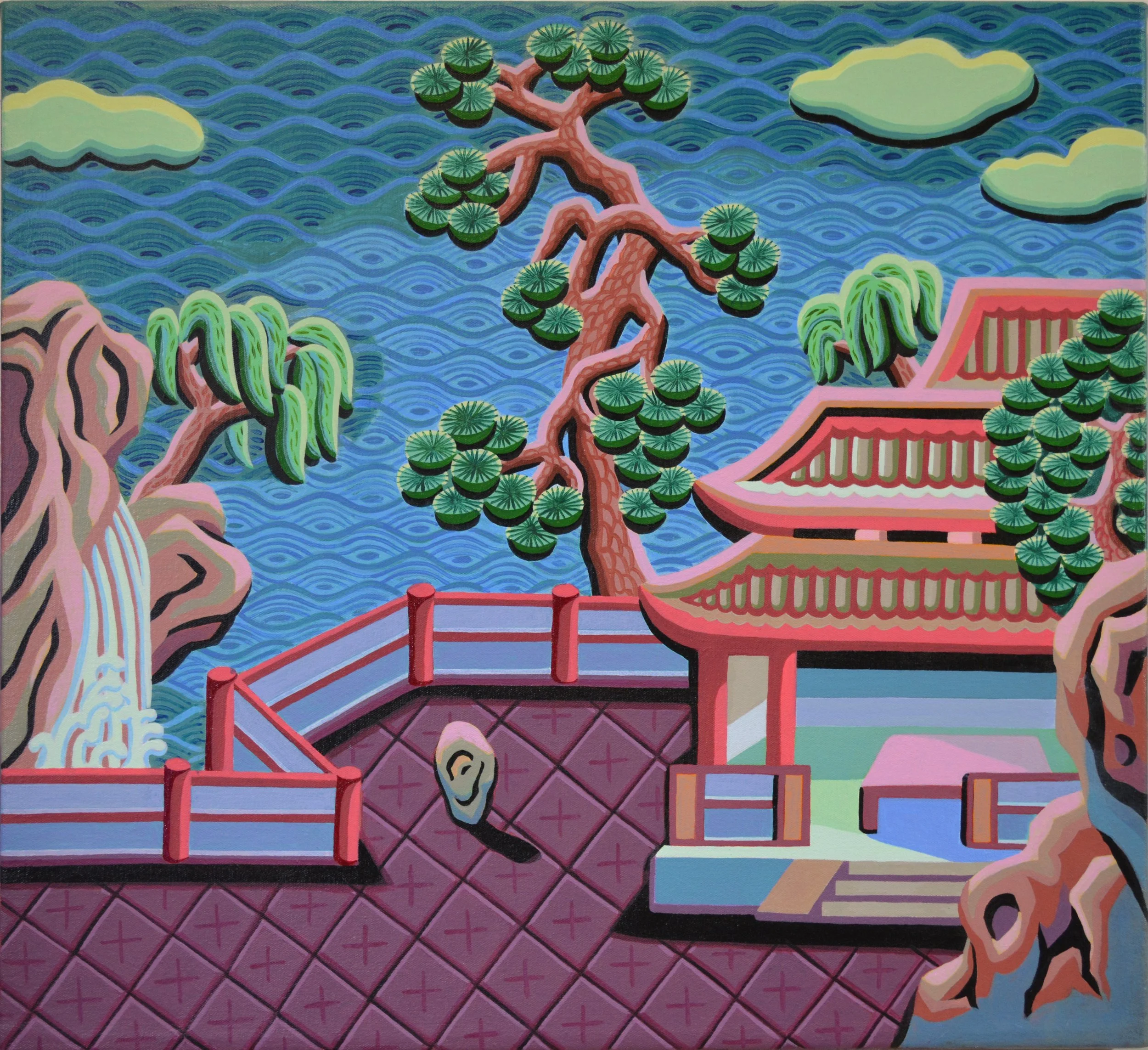
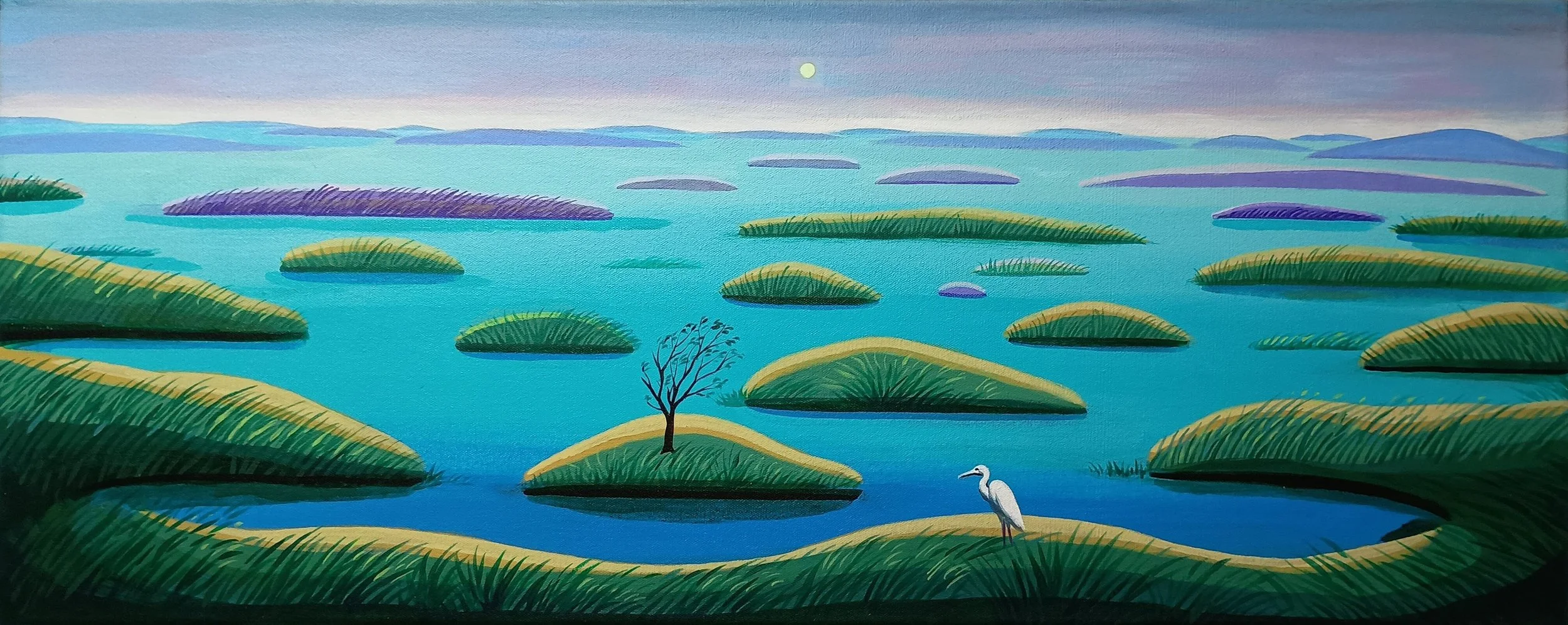
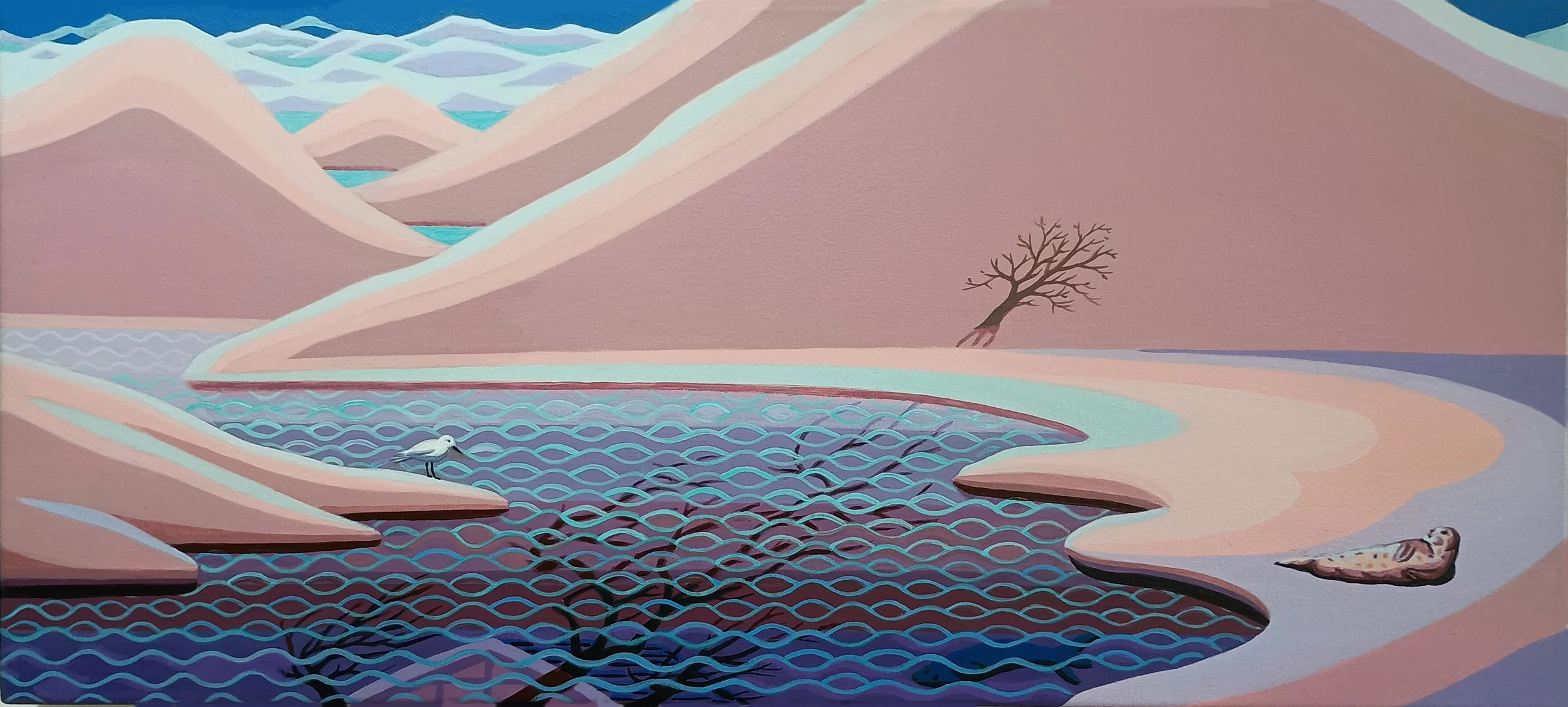
Fan Dongwang, Hope, acrylic on canvas, 36 x 80 cm
$2000
Fan Dongwang
Painting Between Worlds
13 November – 4 December 2025
Art Atrium 48 is proud to present Painting Between Worlds, a body of work by Fan Dongwang that explores how perspective transforms the way we see. Drawing on the Song dynasty poet Su Dongpo’s observation that the same mountain appears differently from each vantage point, Fan considers how our perception is always shaped by position, place, and context. We can never see the mountain’s “true face” precisely because we are within it - a timeless reminder of the limits of our understanding and the necessity of humility.
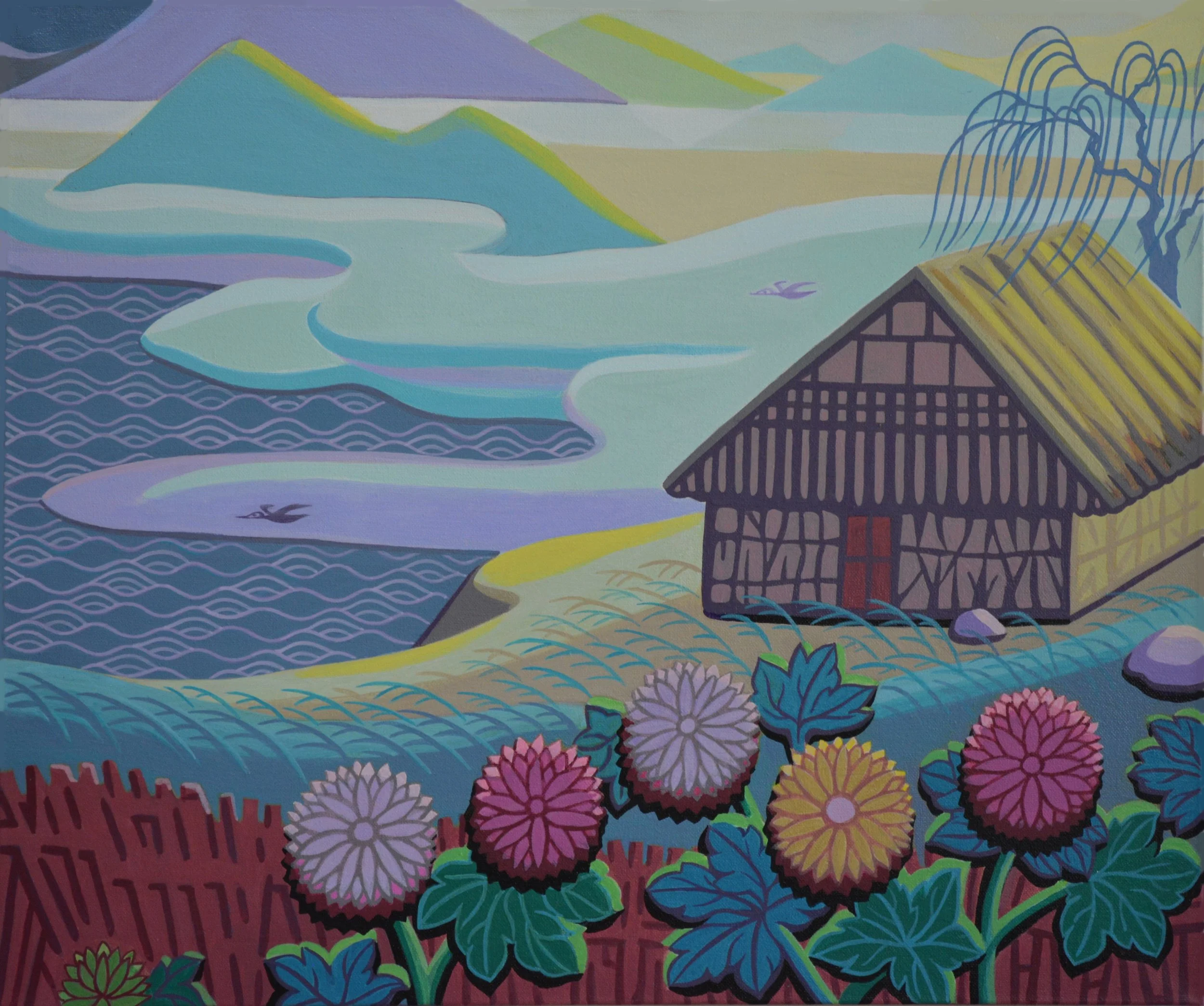
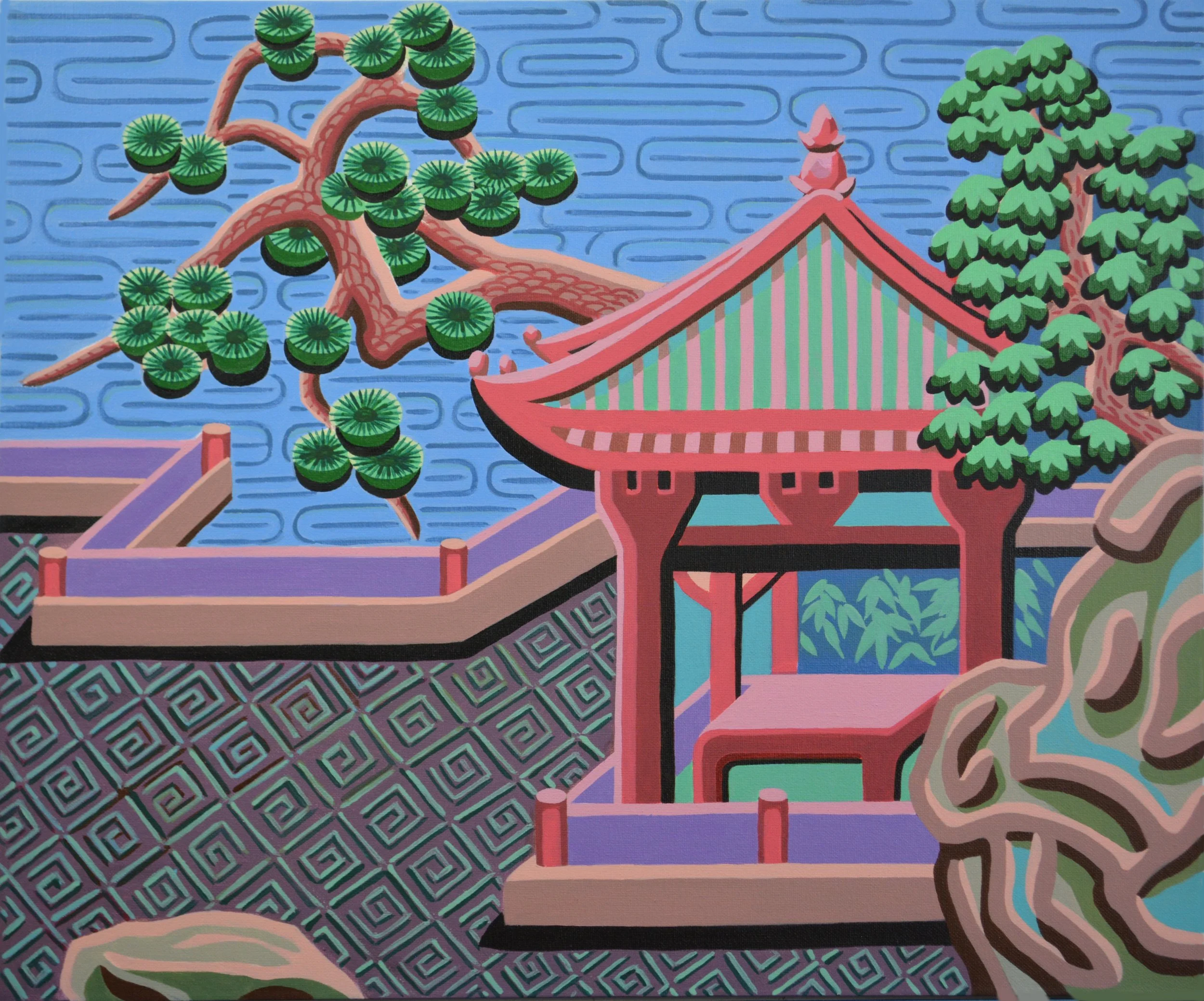
Born and trained in Shanghai before moving to Australia, Fan bridges Eastern and Western artistic traditions, reinterpreting the landscapes of China and Australia - mountains, rivers, and gum trees through the calligraphic brushwork of Chinese painting and the vivid flatness of Pop Art.
Each landscape articulates a dynamic duality - East/West, yin/yang, flatness/depth, ancient/contemporary, structure/fluidity - bringing architecture, memory and nature into a hybrid realm where cultural boundaries blur and recognition emerges through difference.
Revitalising Chinese aesthetic principles within Western contemporary frameworks, Fan’s paintings open new ways of seeing and belonging across personal, cultural and spiritual horizons. Above all, Painting Between Worlds is a cultural bridge - a visual meditation on how we perceive, remember and find meaning in the environments we call home.
Exhibition Opening
Exhibition Opening to be launched by:
Renee Porter
Curator of the Ironbark Gallery, Strathfield Council Library & Innovation Hub)
Thursday 13 November 2025
6:00 - 8:00 pm
Artist Talk
Fan Dongwang
Mary Faith
Director of the Grace Cossington Smith Gallery, Abbotsleigh
Saturday 29 November 2025
2:00 - 4:00 pm
Artist Statement
“The Song Dynasty poet Su Dongpo once wrote of Mount Lu: "From the front, a ridge; from the side, a peak (横看成岭侧成峰)." This image—of the same mountain appearing entirely different depending on one’s vantage point—serves as a powerful metaphor for perception. Su reminds us that reality is never singular; it is shaped by perspective, place, and context. We fail to grasp the mountain’s “true face” precisely because we are within it—bound by our own position. It is a timeless reflection on the limits of understanding and the necessity of humility.
This idea lies at the heart of my exhibition, Painting Between Worlds. As an artist who moves between China and Australia, and who has been trained in both Eastern and Western traditions, I use landscape painting to explore the shifting nature of perspective—cultural, visual, and personal. I reinterpret Chinese mountains and rivers through the lens of Australian Pop Art, while painting Australian landscapes—especially the gum tree—using the fluid, expressive brushwork of Chinese Calligraphy and ink painting.
My process could be described as a form of visual archaeology. I call it "painting through carving": I use the brush not only to depict but to sculpt space, evoking the texture and depth of low-relief Chinese jade or lacquer carvings. Lines, patterns, and shadows emerge as if etched from the surface of the canvas, creating the illusion of form rising out of flatness. This tension between two-dimensionality and depth mirrors the spatial ambiguity found in traditional Chinese decorative arts. Meanwhile, elements of Western postmodernism and linear perspective are woven into the work—not to replace but to extend classical Chinese aesthetics into new visual conversations.
The bold colours and flat surfaces in my work reflect the influence of Pop Art, Hard Edge abstraction, and Op Art—artists like Roy Lichtenstein, Kandinsky, and David Hockney resonate alongside Hokusai and the great Chinese painters of the past. This blending of influences gives rise to a hybrid visual language, one that shifts and oscillates between East and West, ancient and contemporary, flatness and depth.
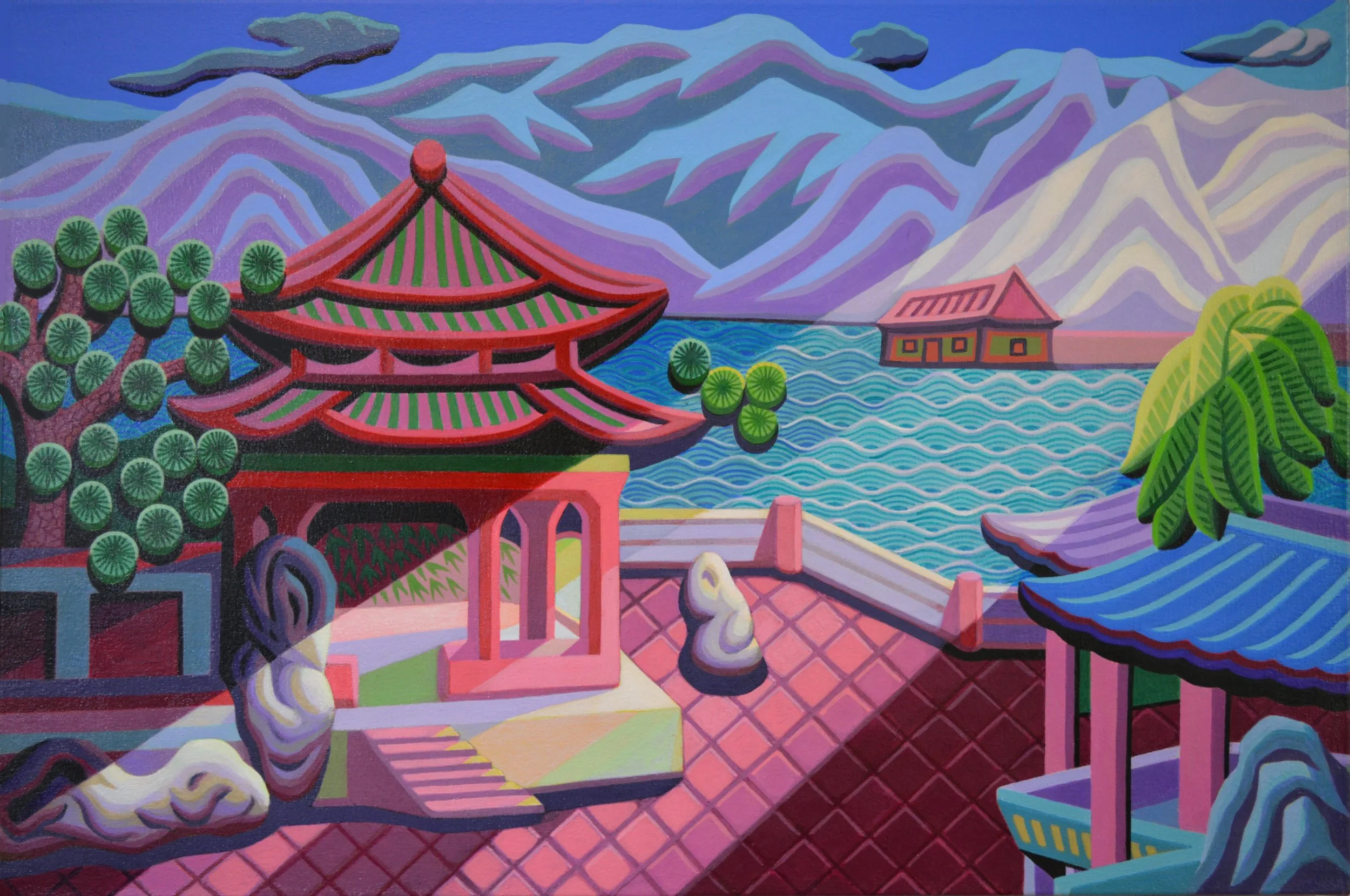
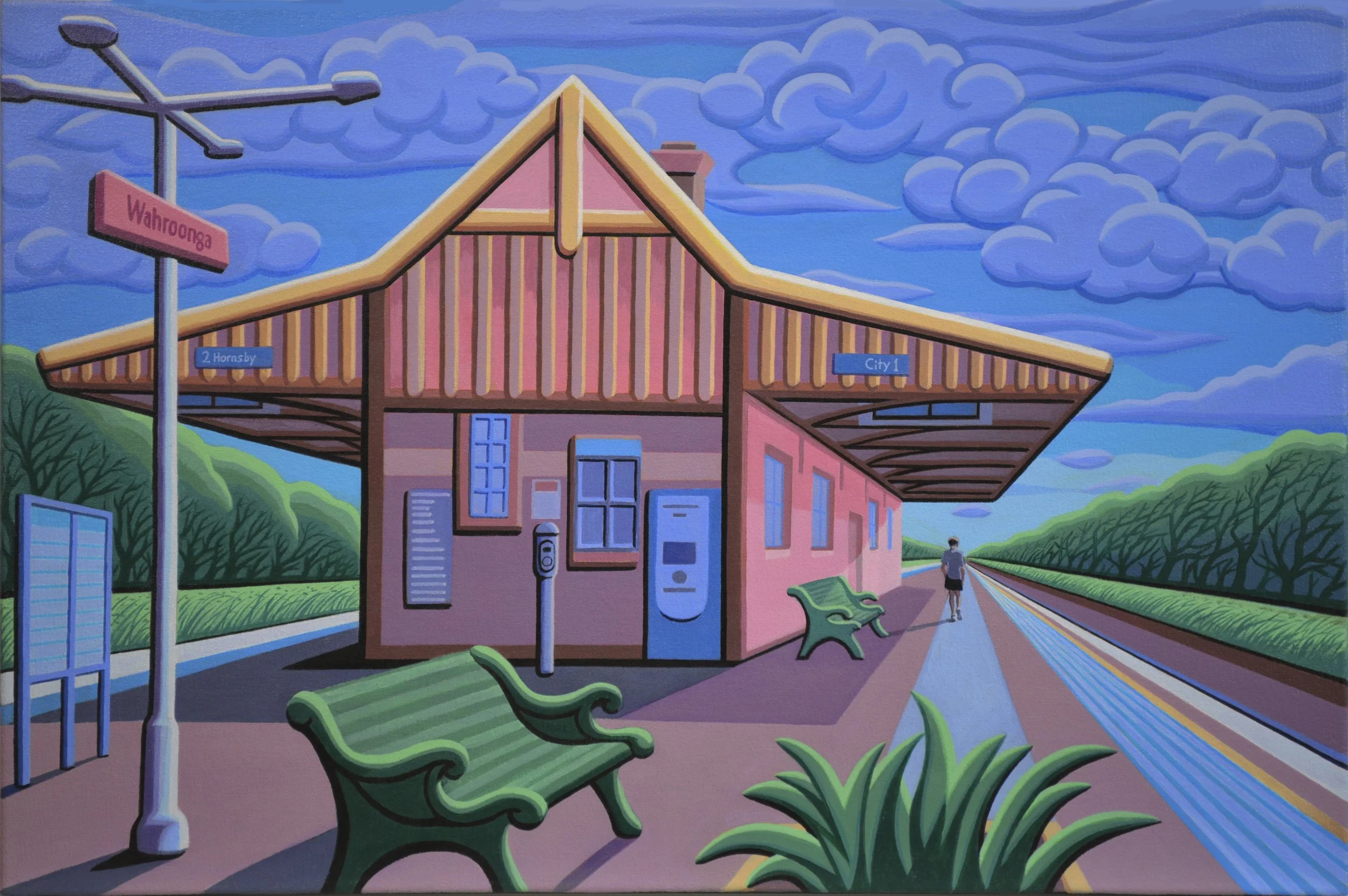
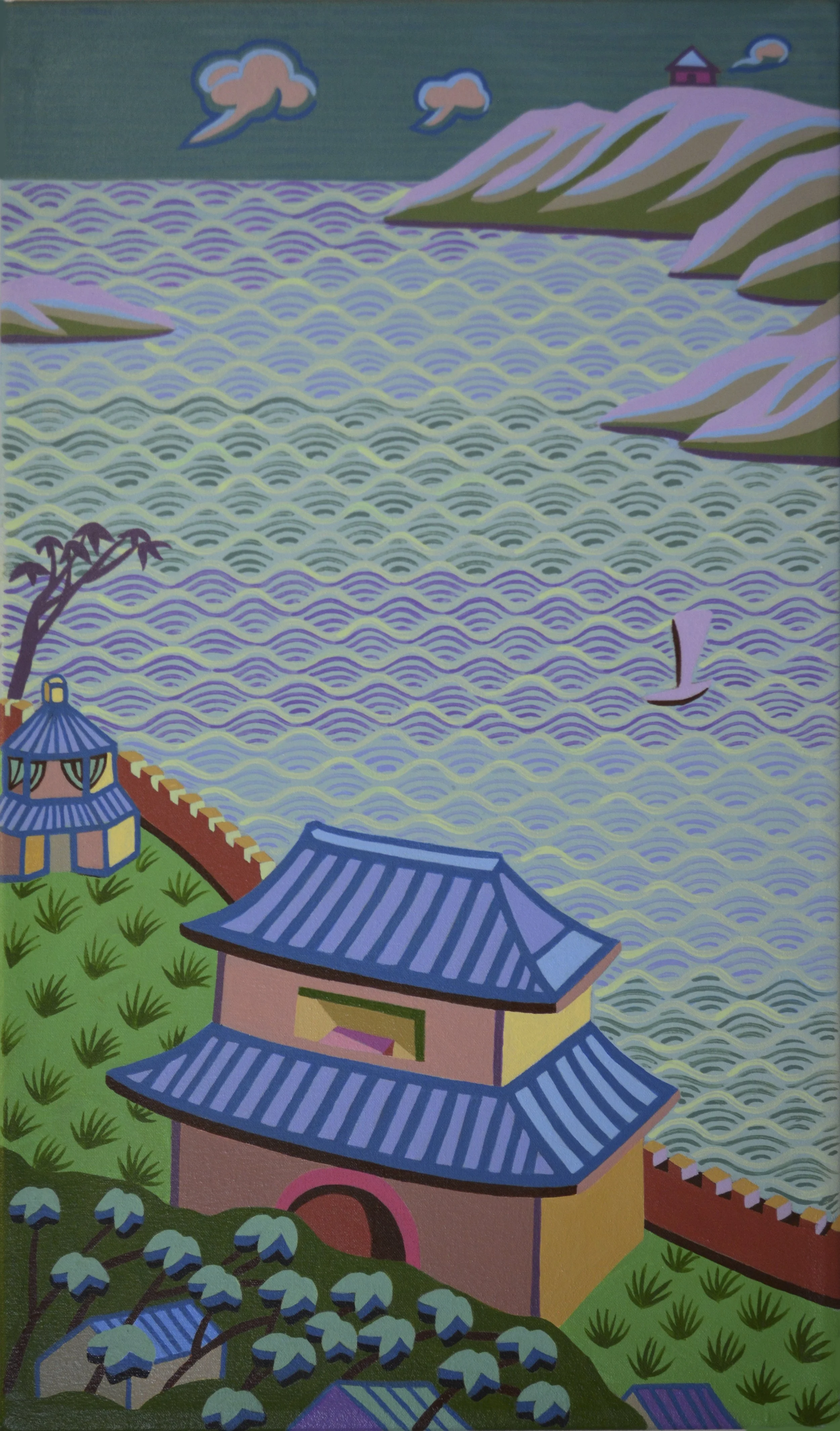
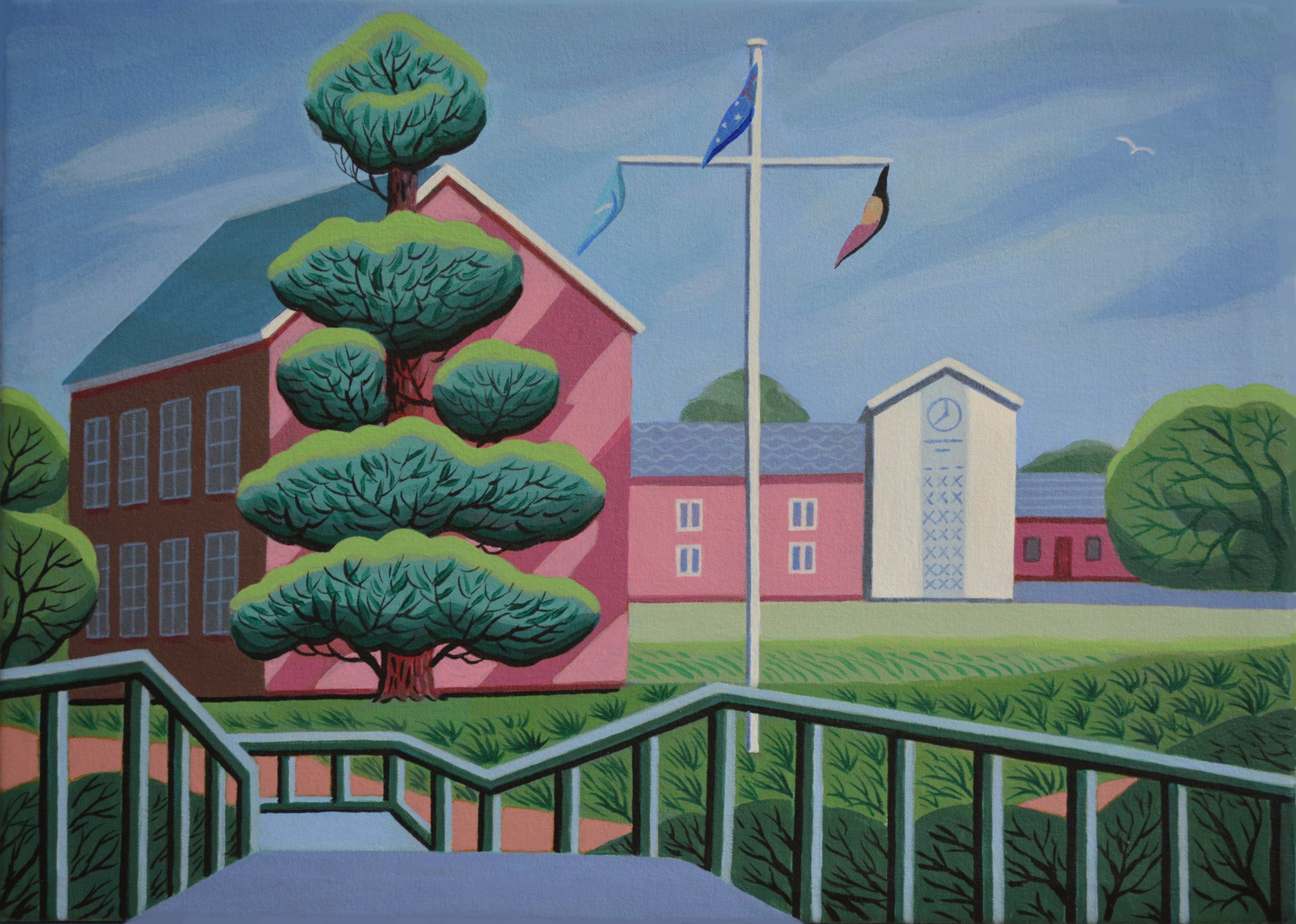
Architecture plays a key role in my work as well. In a series of paintings depicting the palaces of Beijing, I evoke imperial gardens of the Qing dynasty, where towers, pavilions, and courtyards become emblems of cultural identity and historical memory. A simple structure like the Wahroonga Railway Station in suburban Sydney, for instance, transforms under my brush into something akin to a garden pavilion or mist-shrouded lakeside teahouse. In Deck and Watery Sky (2024), my own Sydney home is reimagined as a scholar’s garden—a place for quiet contemplation of the moon, bridging personal space and poetic tradition.
The natural elements of 山 (mountains and rocks) and 水 (water, lakes, rivers, clouds, waterfalls) are central to my landscapes, embodying the core principles of Daoist philosophy. These compositions reflect the traditional Chinese view that gazing upon nature connects us to the greater universe. The dualities of Yin and Yang, Hard and Soft, Solid and Void are embedded in each brushstroke—offering not only spiritual insight but also a meditation on our fragile relationship with the natural world. Environmental concerns, too, are folded into this dialogue.
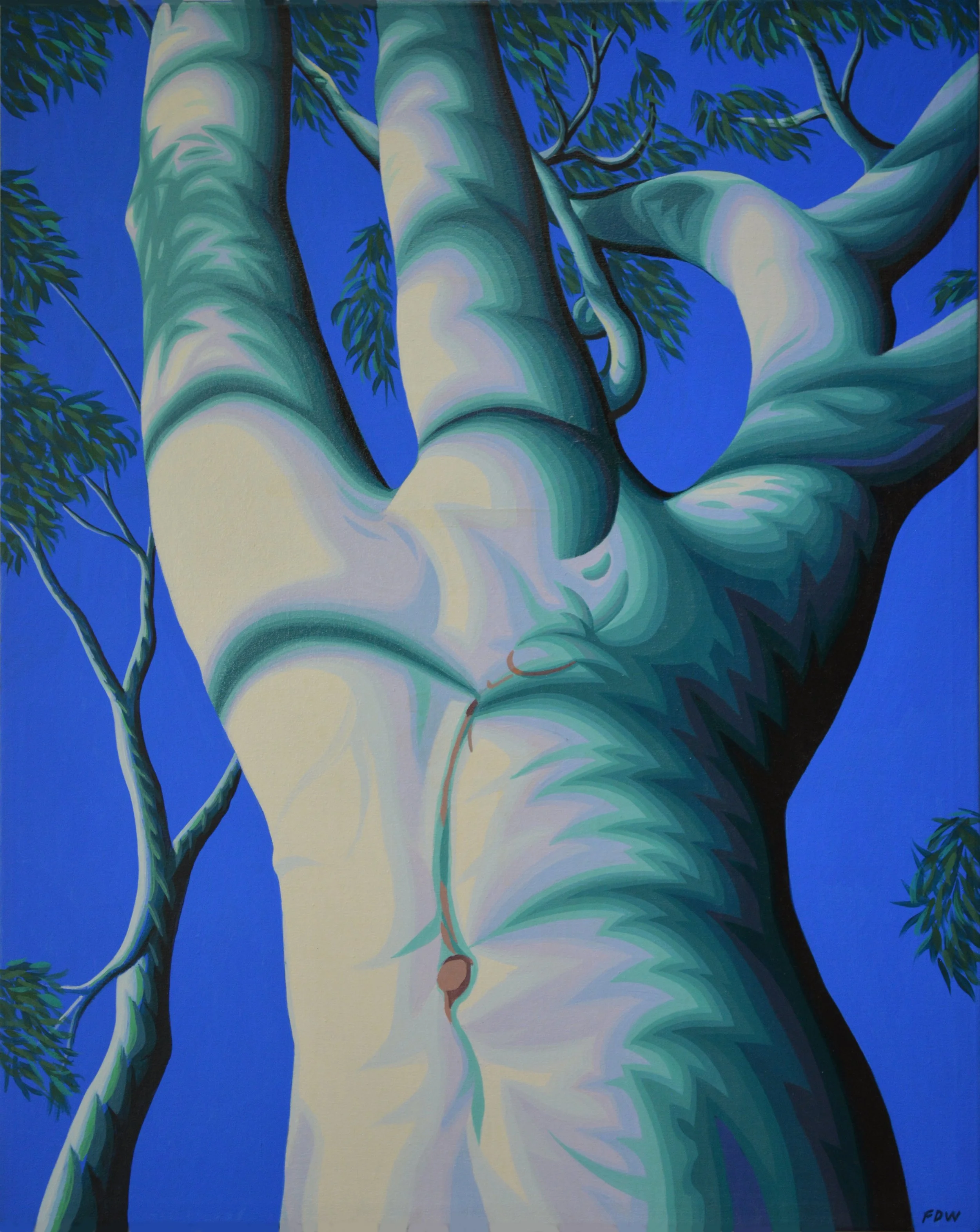
In my Gumtree series, I explore the Australian landscape as a site of cultural translation. The gum tree—resilient and distinctly Australian—becomes a metaphor for endurance. These trees survive fire, drought, flood, and time; season after season, they return. Under my brush, their trunks twist and dance, their branches stretch like calligraphic gestures, full of motion and vitality. They become living characters—calligraphies rooted in the earth, yet reaching toward the heavens.
Whether I’m painting Chinese mountains and pavilions or Australian forests and gum trees, all my landscapes inhabit the same contemplative space—a place beyond geography, rooted in shared human experience. Each work invites viewers into a realm where cultural boundaries blur, and recognition emerges through difference. These are landscapes that belong to no single tradition, yet speak across traditions.
Through the revitalization of Chinese aesthetic principles within the frameworks of Western contemporary art, I offer new ways of seeing and belonging. For Australian audiences, this perspective adds new layers to the country’s evolving landscape tradition—once Eurocentric, now deeply enriched by Indigenous knowledge, and further expanded by Asian visual philosophies. Painting Between Worlds is more than an artistic process; it is a cultural bridge, a visual meditation on how we perceive, remember, and find meaning in the environments we call home.” — Dr. Fan Dongwang
About the Artist
Born in Shanghai, Dr Fan Dongwang received formal training in traditional Chinese art at the Shanghai School of Arts and Crafts (SSAC) during the 1970s. As an established figure in Shanghai’s art scene, he began exhibiting regularly from 1982 and gained early recognition through inclusion in major national exhibitions such as the 1986 Shanghai Art Exhibition. A member of the Chinese Artists Association, he received the Prize for Excellent Work at the Shanghai International Culture Exchange, recognising his early contribution to cultural dialogue and innovation.
In the 90s, he migrated to Australia as an artist of Distinguished Talent, a rare recognition of artistic excellence and international cultural contribution. He went on to earn a Master of Arts from the College of Fine Arts, University of New South Wales, in 1995, and later received a Postgraduate Award leading to a Doctor of Creative Arts from the University of Wollongong in 2000. Dr Fan Dongwang currently lives and works in Sydney, Australia.
Over the past four decades, his work has been exhibited extensively across China and Australia. Early exhibitions include the Shanghai Art Museum Inaugural Art Exhibition, the Shanghai International Art Festival at the Shanghai Art Gallery. His work has also been shown at the National Gallery of Australia and in numerous university and regional art galleries throughout the country. Other notable exhibitions include the Australian Drawing Biennale at the Drill Hall Gallery, ANU; the national touring exhibition Shanghai Star, organised by Casula Powerhouse and touring to ten regional galleries; and Coming Home – 30 Chinese/Australian Artists, at Linda Gallery, 798 Art District, Beijing. His practice has also been featured in Contemporary Art from the City Fringe at Carriageworks, Sydney (2009 and 2010); Controversy & Acclaim – 60 Years of the Mosman Art Prize (2009); Australian Art at the Beijing 798 Art District (2012); and Crossing Boundaries, City of Sydney Chinese New Year Festival Art Exhibition (2014). and The Trace is not Present at the Chau Chak Wing Museum, University of Sydney (2024–2025).
Dr Fan Dongwang has been a finalist in several of Australia’s most respected art awards, including the AGNSW Sulman Prize, Wynne Prize, and Doug Moran National Portrait Prize. He also participated in the Blake Prize Touring Exhibition, Review and Prospect: Chinese-Australian Artistic Achievement at the NSW Parliament House, and the Kilgour Prize at the Newcastle Art Gallery. His work was later included in Between Two Worlds at the Newcastle Art Gallery (2019–2020), the Northern Beaches Environmental Art and Design Prize (2024–2025),
Dr Fan Dongwang’s solo exhibitions trace his evolving engagement with landscape, identity, and transcultural expression. These include Shifting Perspectives: Paintings 1995–2015 at the University of Newcastle (2015); Icons of Identity at 541 Art Space, Sydney (2017); Syncretic Visions at McGlade Gallery, Australian Catholic University (2018); Duality at Art Atrium Gallery, Sydney (2019); Pandemic Body at Macquarie University Art Gallery (2021); Sculptural Painting at Art Atrium Gallery, Sydney (2023); and Traditions and Transformations at the Institute for Australian Culture and Society, Western Sydney University (2023). More recent exhibitions include Empyrean Landscape: The Year of the Dragon at Hurstville Museum & Gallery (2024), Carving Perspectives at Grace Cossington Smith Gallery, Abbotsleigh (2025), and Symphonic Trees at Strathfield Library & Innovation Hub (2025).
Dr Fan Dongwang has been the recipient of numerous awards and grants recognising his artistic excellence. These include the University of Wollongong Postgraduate Award, multiple Australia Council New Work Grants, and the Ian Potter Cultural Trust Grant. He has won the Mosman Art Prize, the Festival of Fisher’s Ghost Art Award, the Liverpool Art Prize, Art on the Rocks Prize, the Willoughby Art Prize, and the Burwood Art Prize. More recently, he received the Create NSW Project Funding (2023), the Blacktown Art Prize People’s Choice Award (2025), the Cultural Connection Grant from Inner West Council (2025), and the Northern Beaches Environmental Art and Design Prize People’s Choice Award (2025). During the pandemic, he was awarded Create NSW, Australia Council for the Arts, and NAVA 2020 COVID-19 Response Funding in support of his ongoing practice.
Major public commissions include Descendant Installation for the National Gallery of Australia; Dragon Installation at Dawes Point for the Sydney Chinese New Year Lantern Exhibition (2016–2017); Dog Installation at Sydney Chinatown for the Sydney City Council Chinese New Year Lantern Exhibition (2018–2021); Pandemic Body, created for Art in the Time of COVID-19, Nillumbik Shire Council (2020); and the Empyrean Dragon Banner Exhibition on George Street, City of Sydney (2024).
Dr Fan Dongwang’s works are held in numerous public, institutional, and corporate collections, including the Shanghai Art Museum, Art Gallery of Western Australia, Artbank Australia, Sydney Harbour Foreshore Authority, City of Sydney Council, Mosman Council, Burwood Council, Wollongong City Gallery, Campbelltown City Gallery, Casula Powerhouse, Dubbo Regional Gallery, Manning Regional Gallery, and Maitland Regional Gallery. His works are also represented in the collections of the Australian National University, University of Sydney, UNSW, Macquarie University, University of Wollongong, Curtin University, University of Western Australia, University of Newcastle, Murdoch University, and Charles Sturt University. Additional holdings include the Australian Centre for Christianity and Culture, John Curtin Gallery, City of Wanneroo, Hurstville Council, Grace Cossington Smith Gallery, Abbotsleigh, and his alma mater, the Shanghai School of Arts and Crafts.
ARTWORK
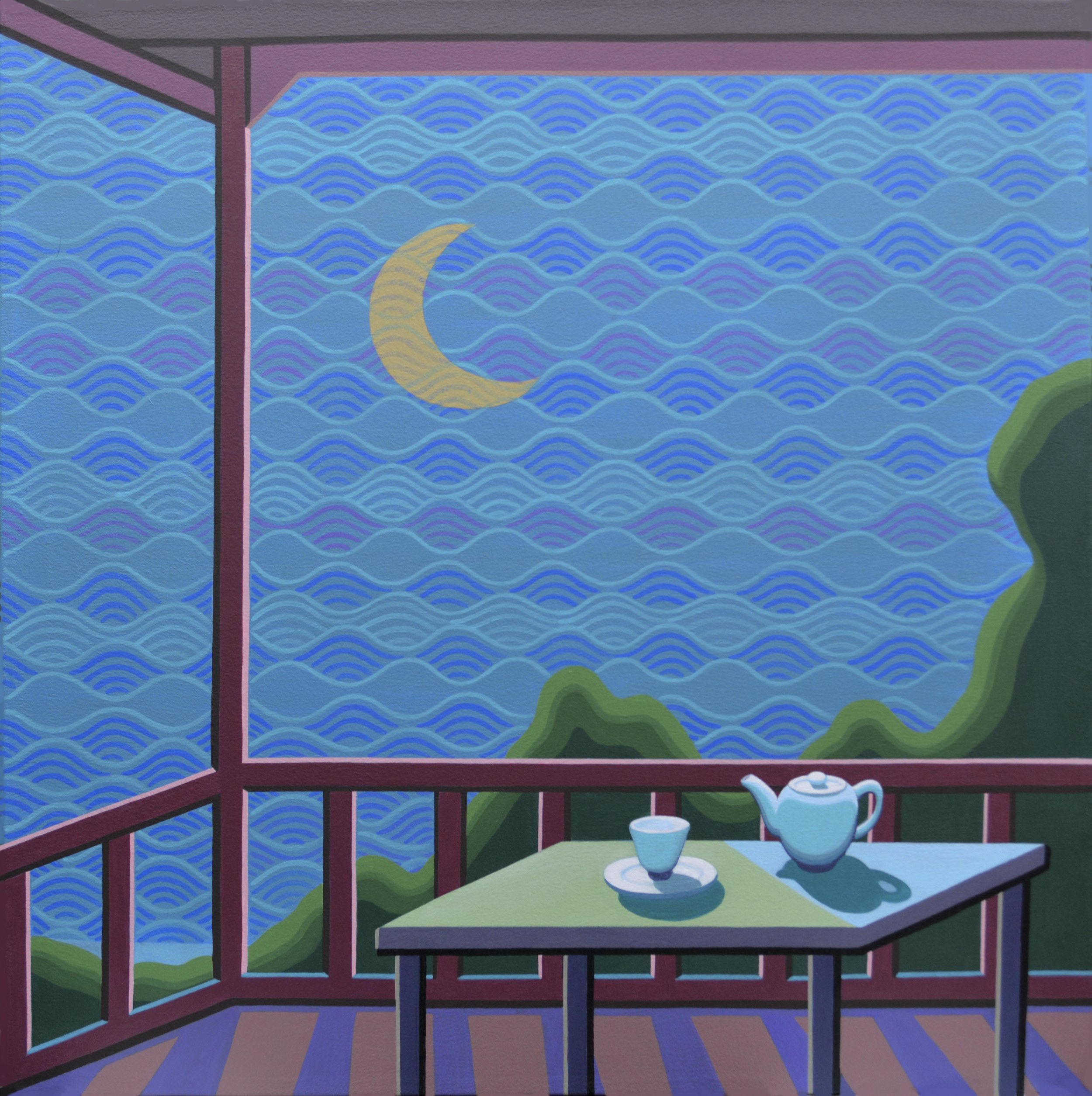
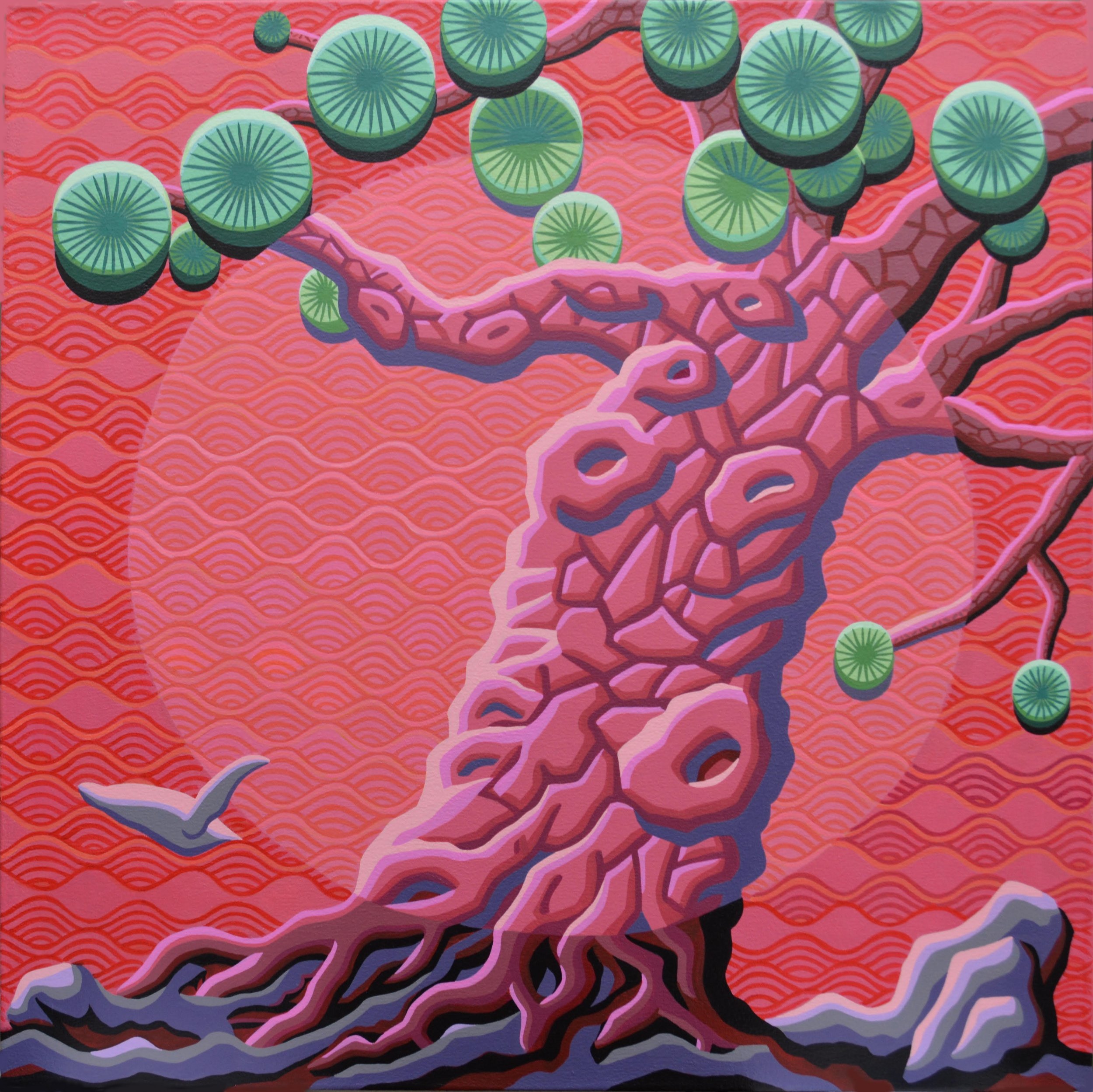
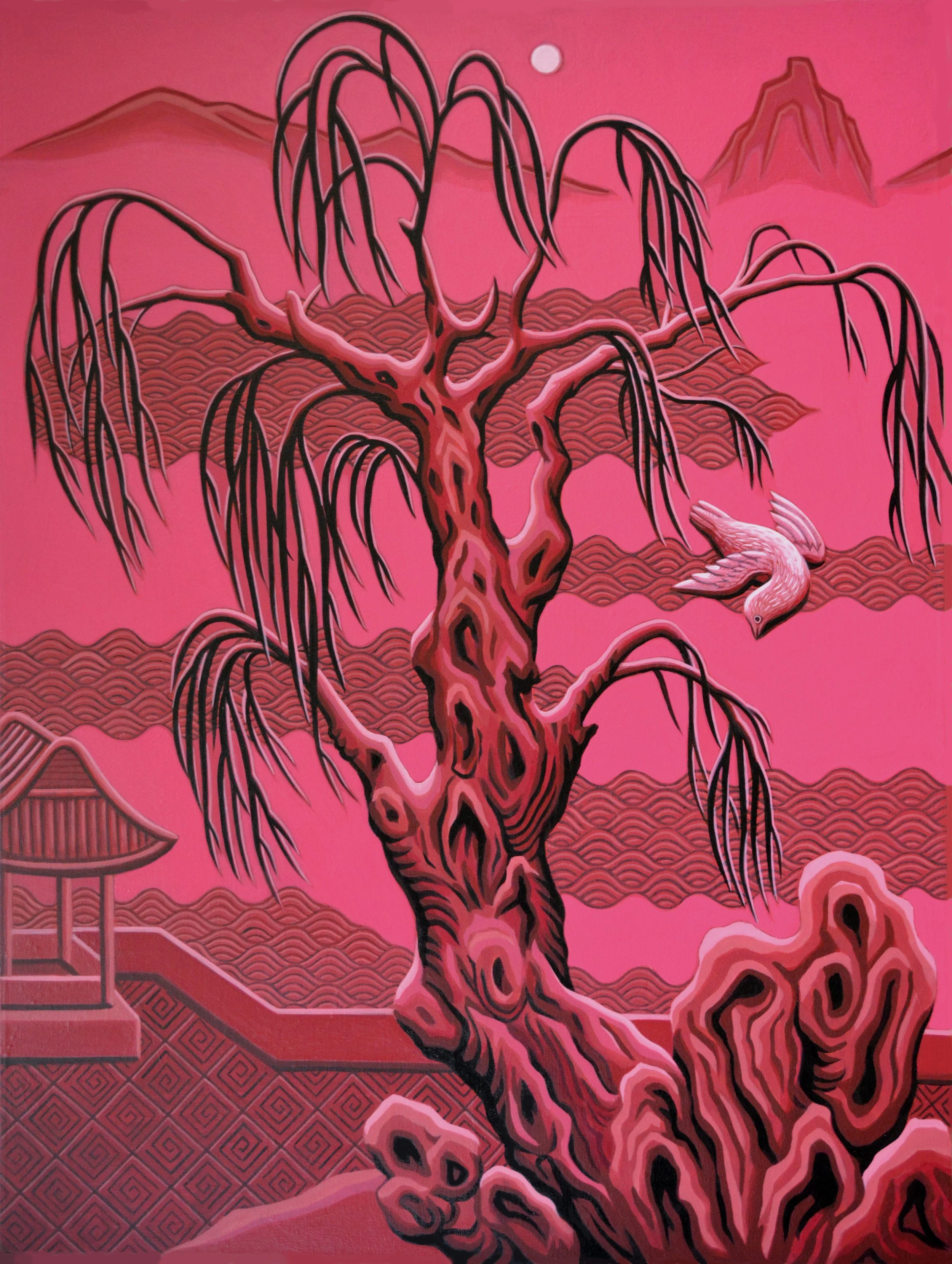


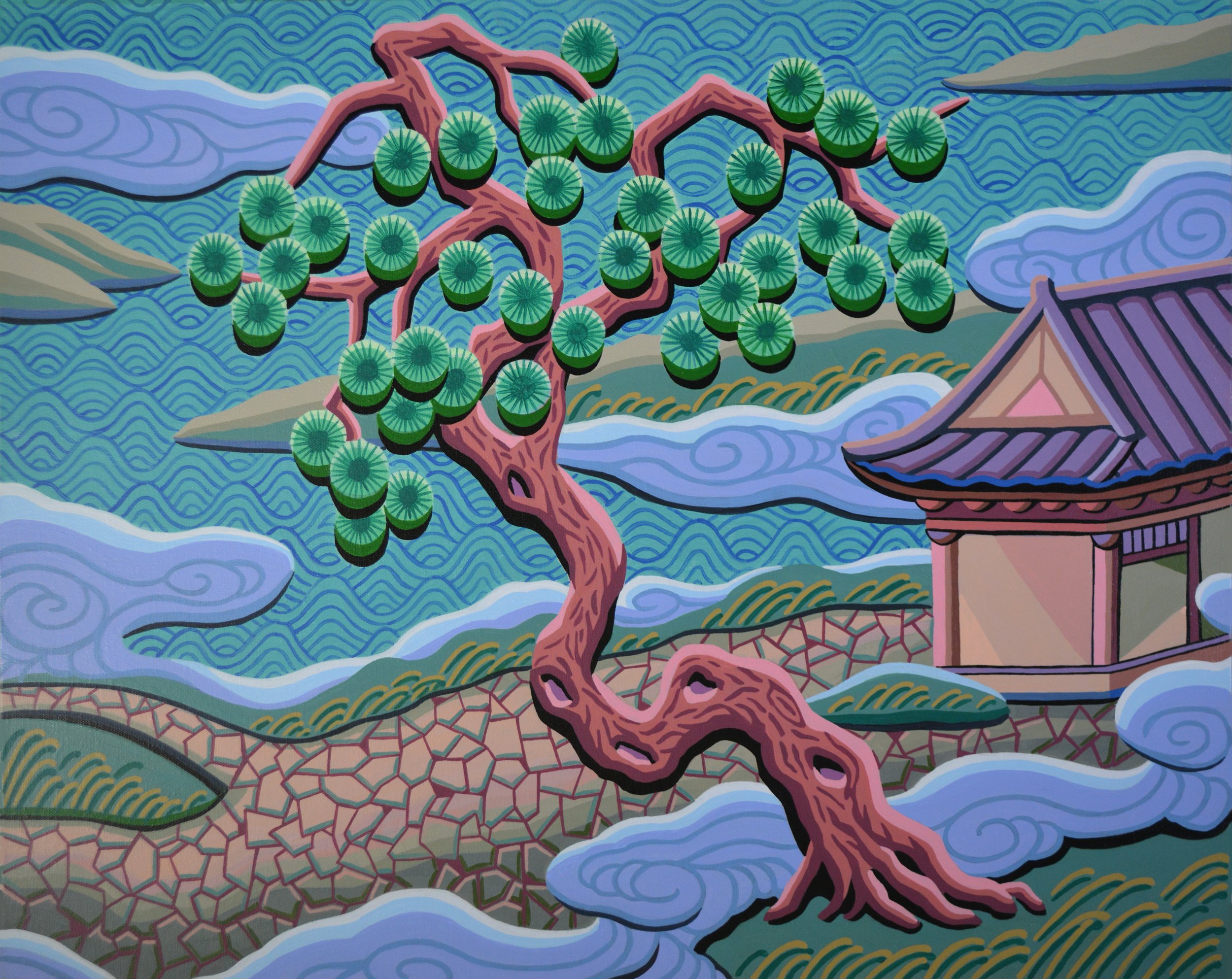
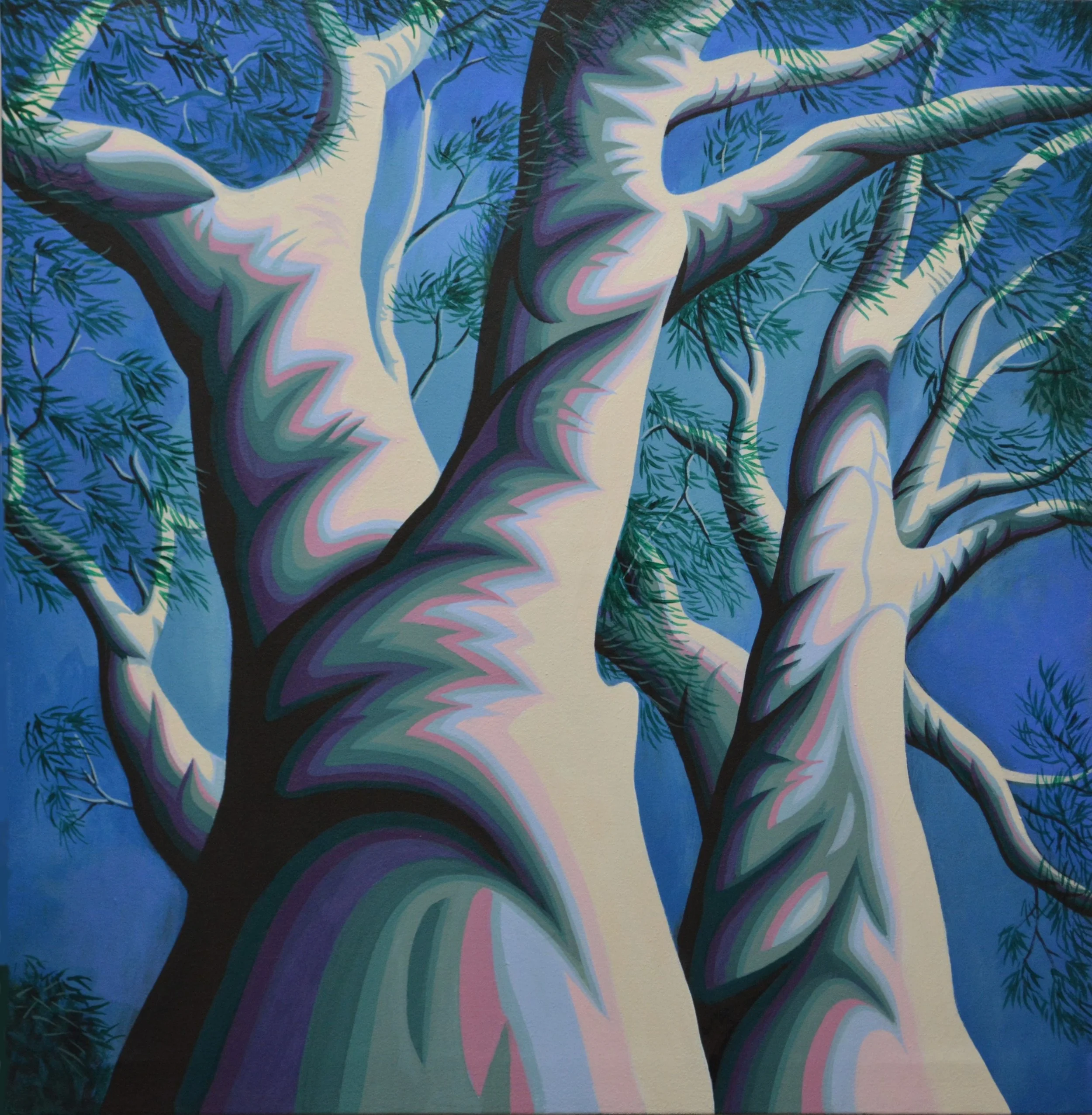
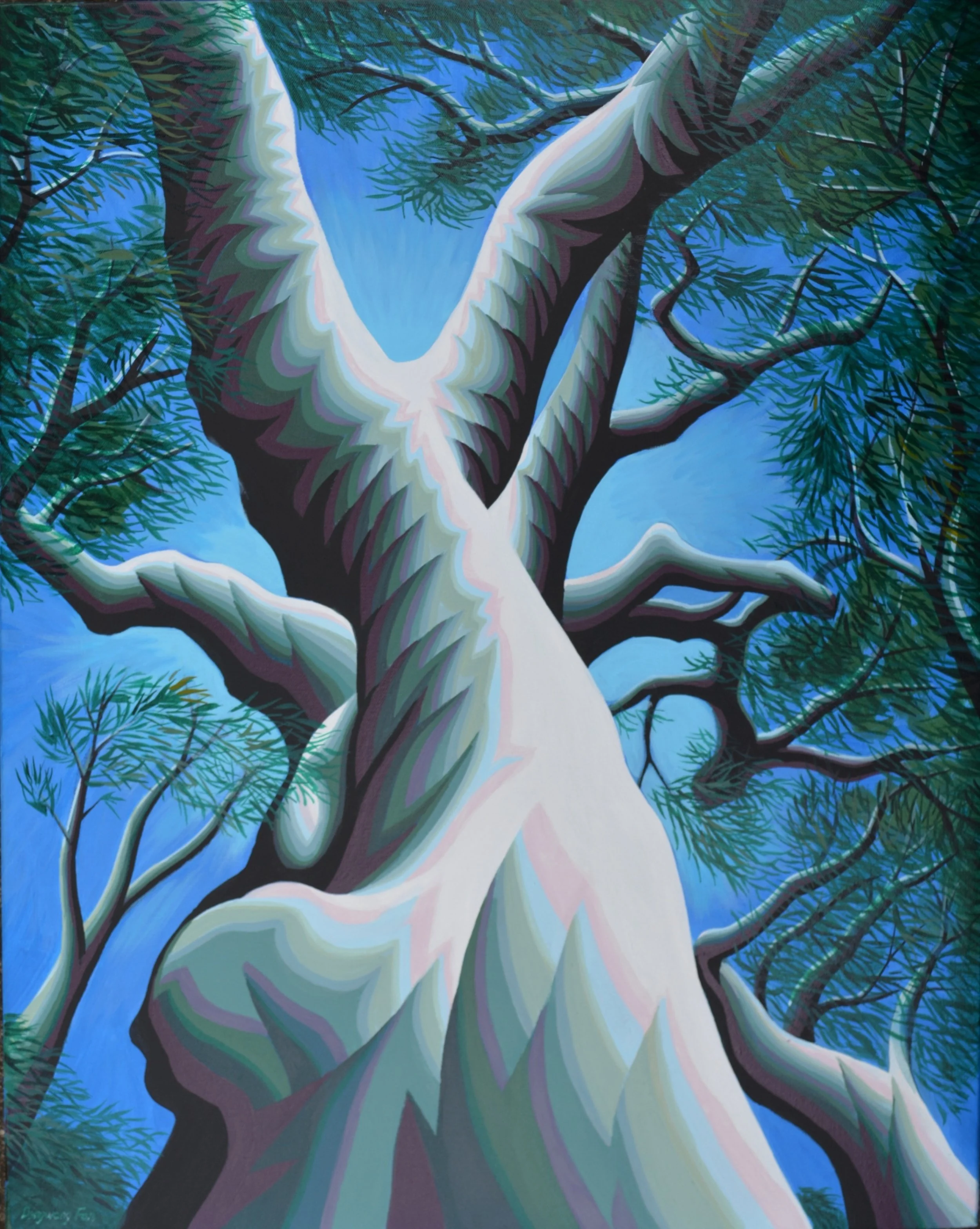
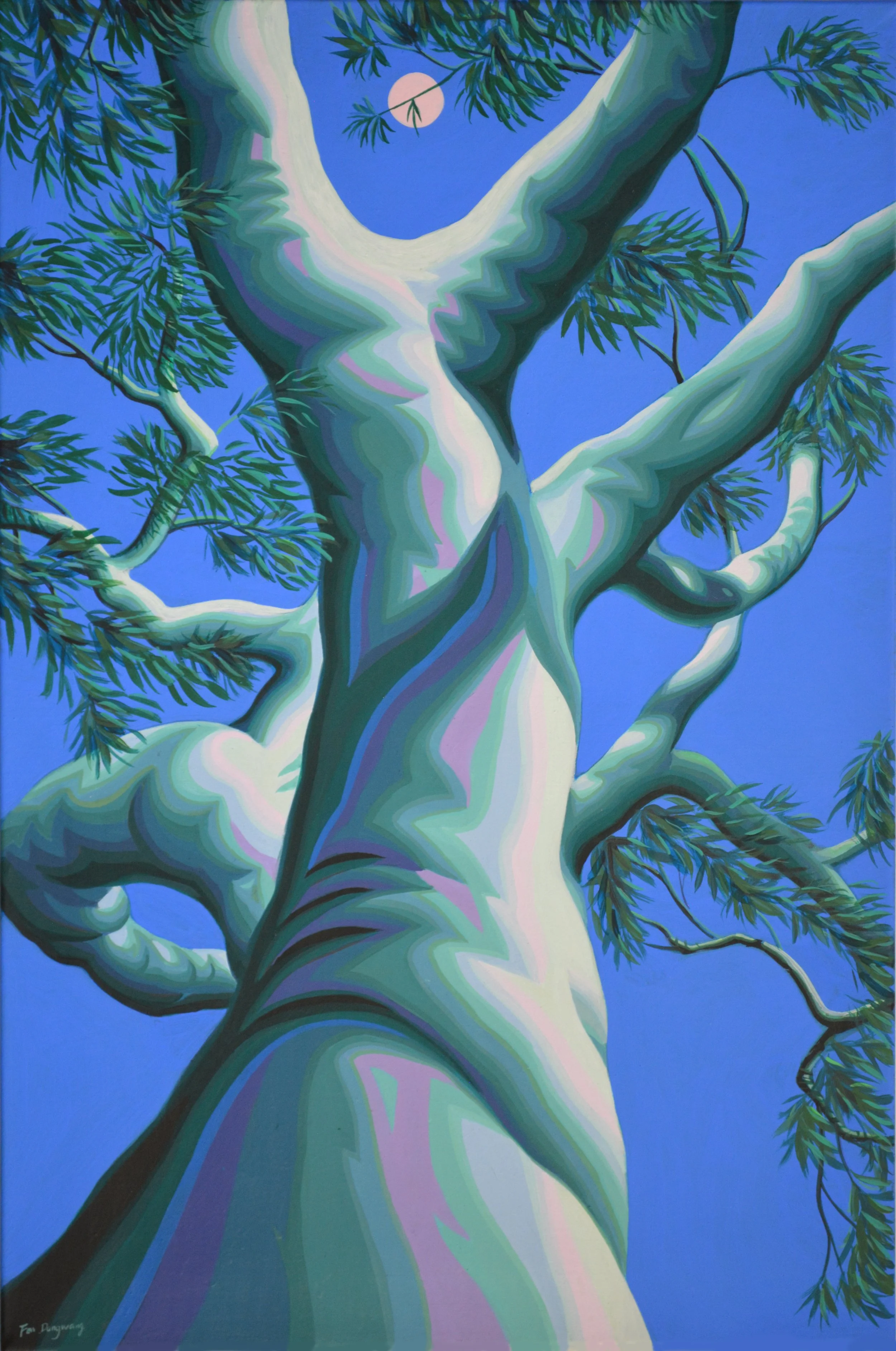
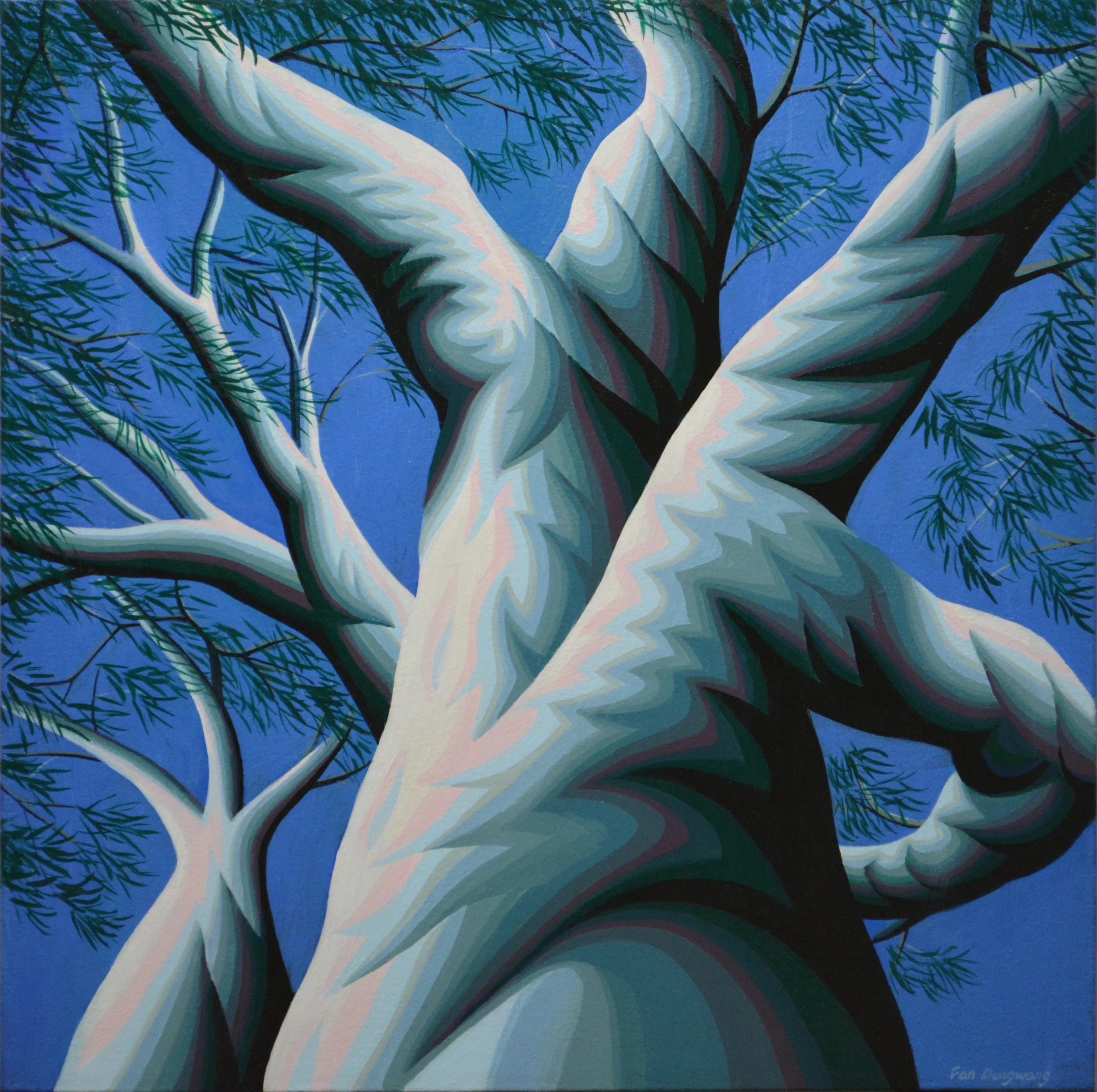
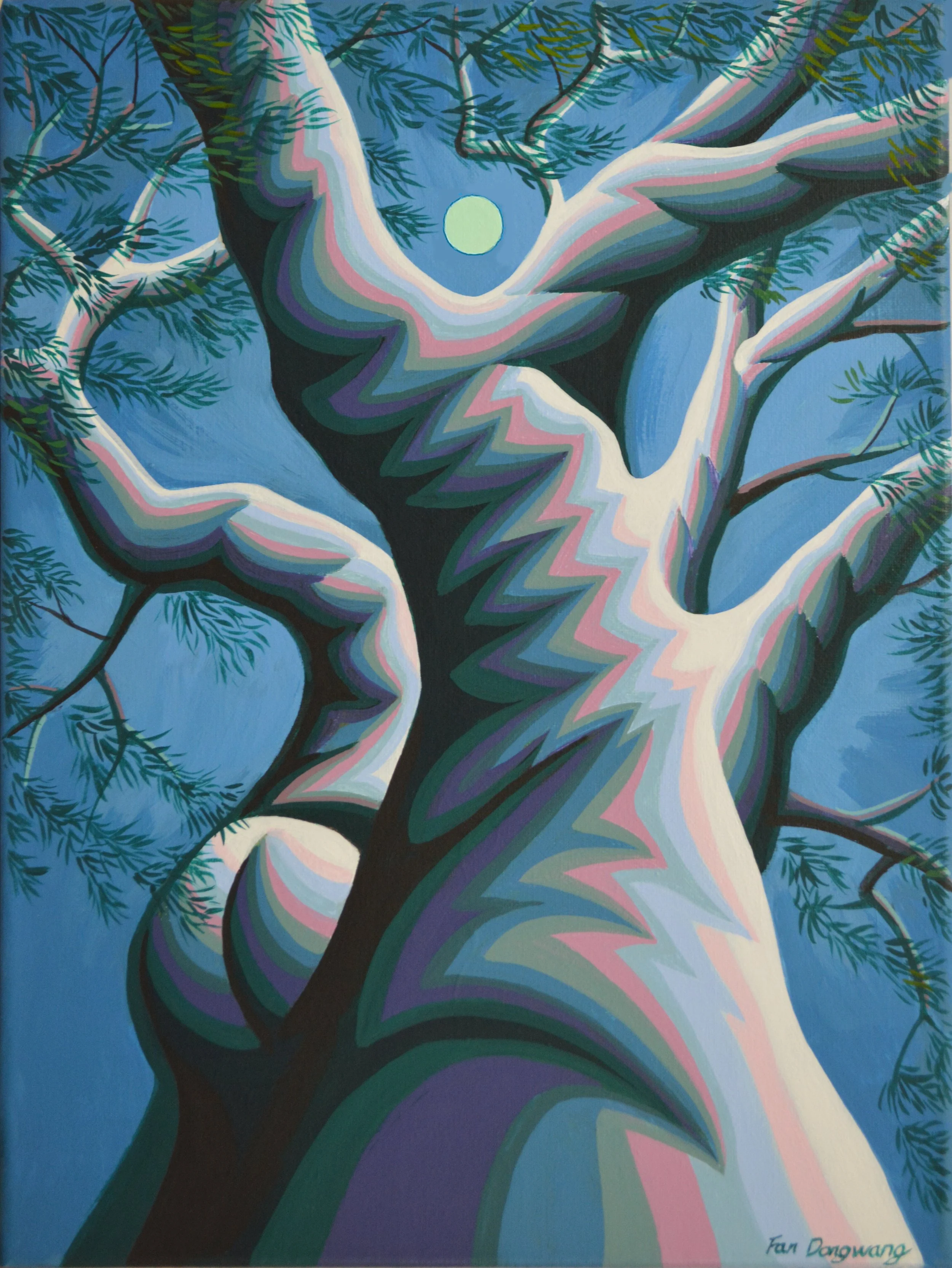
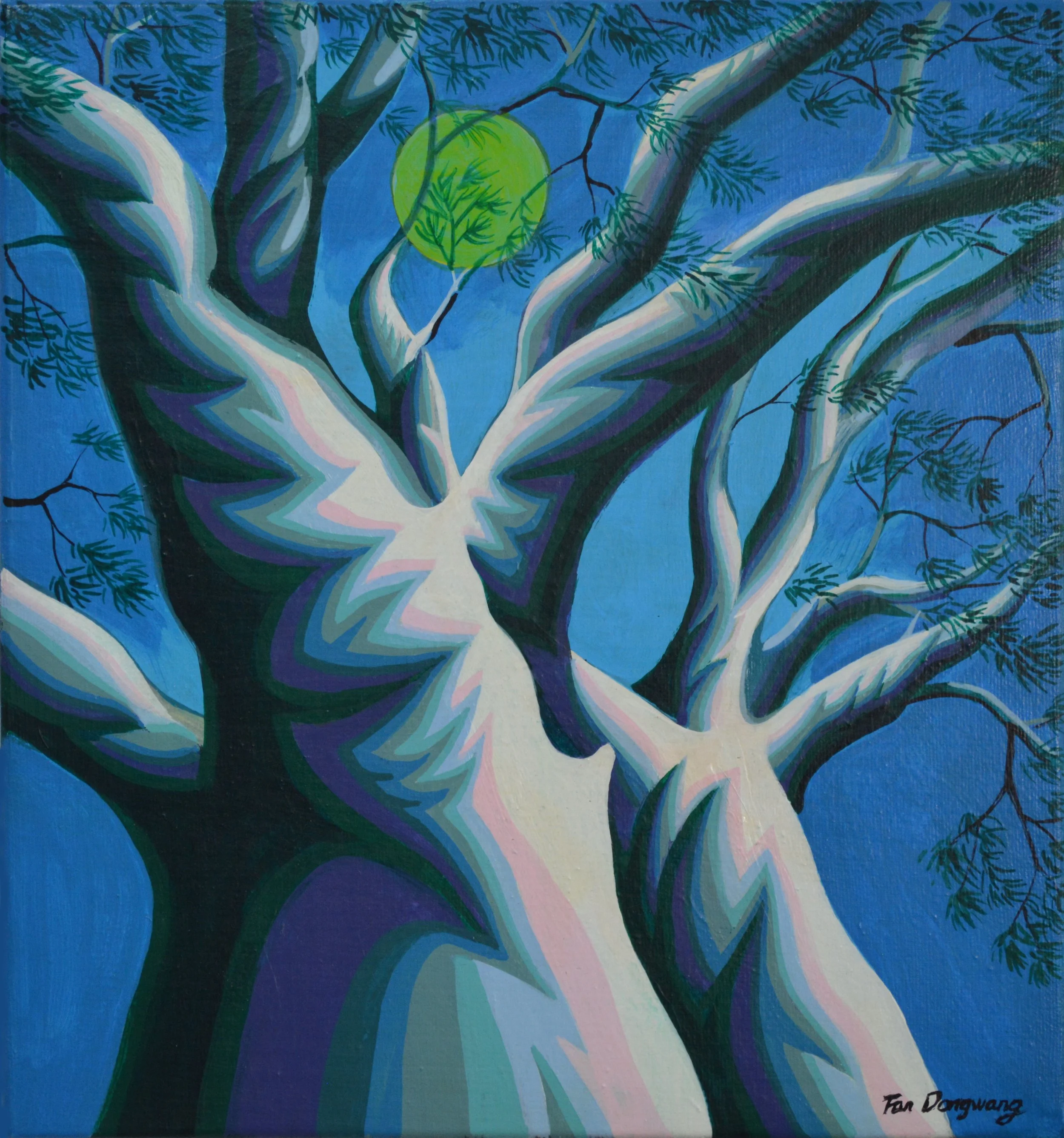
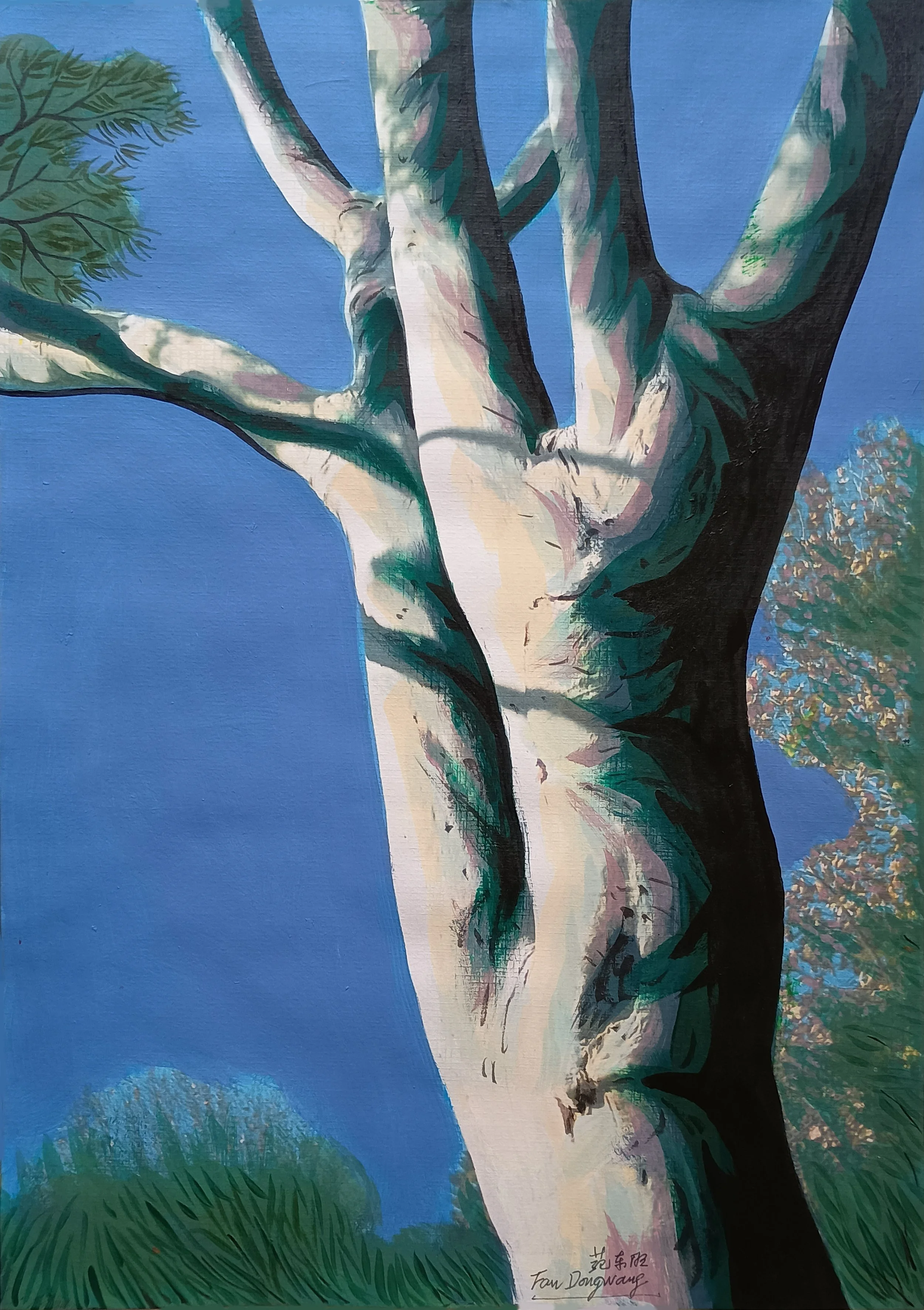
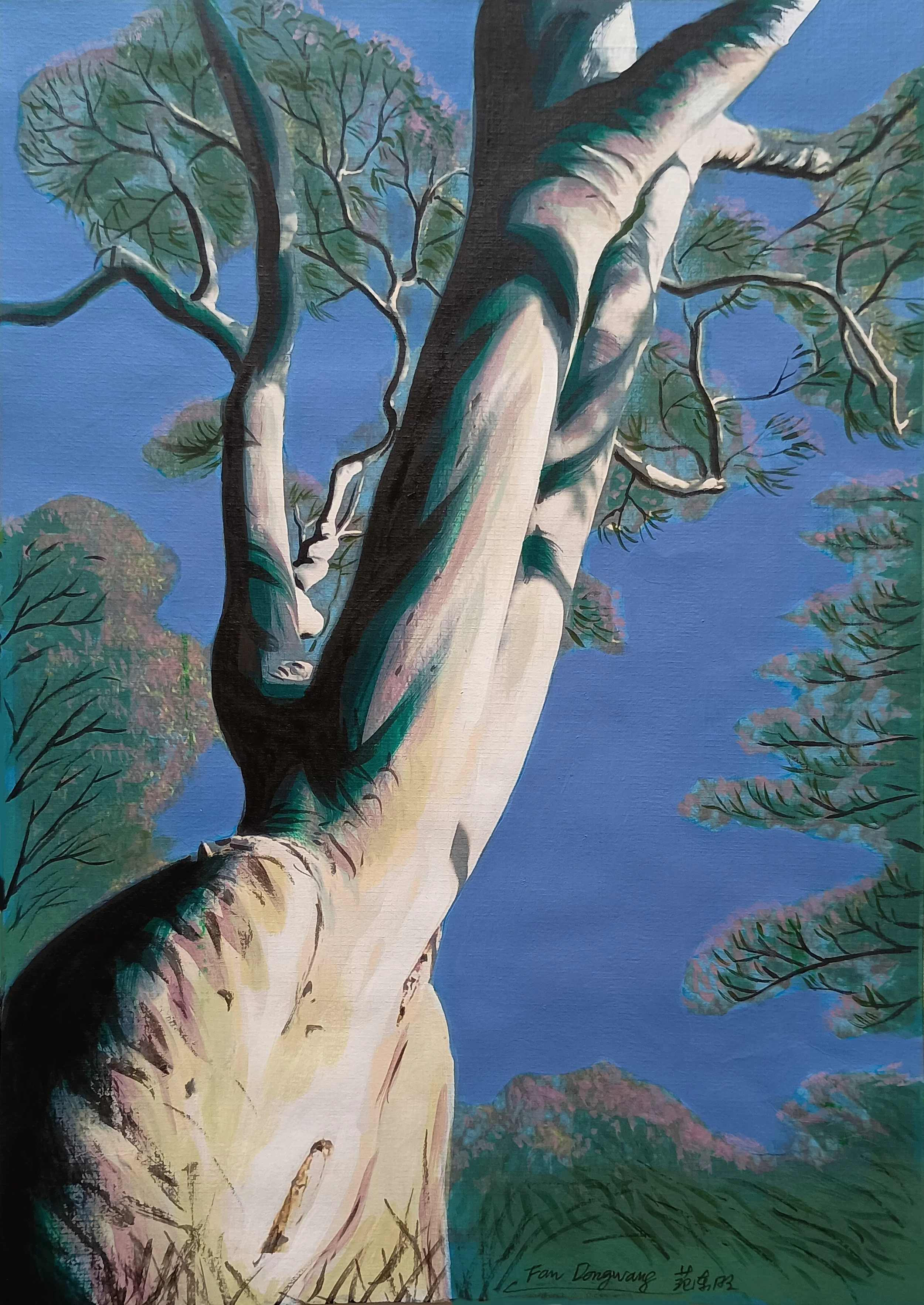
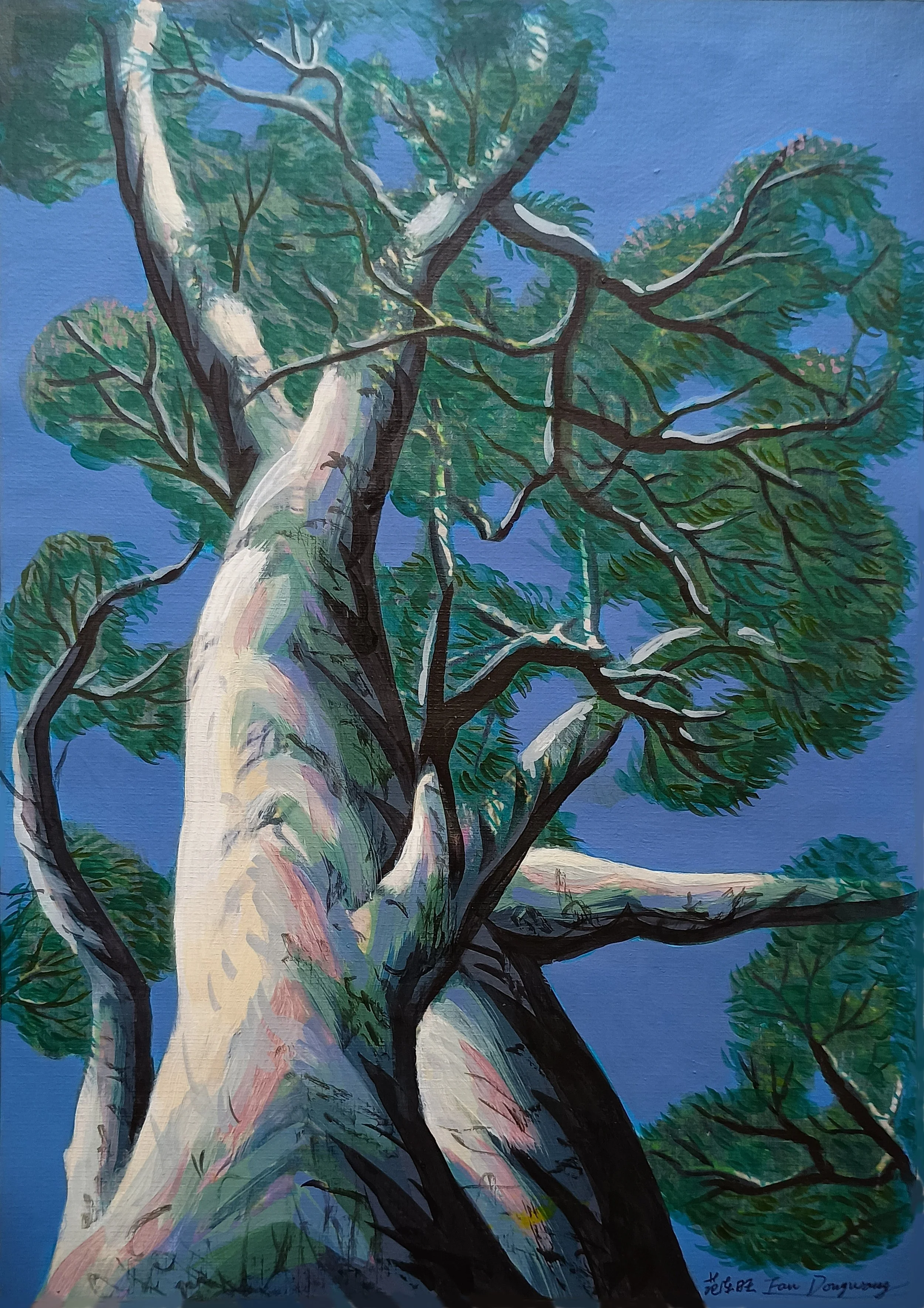
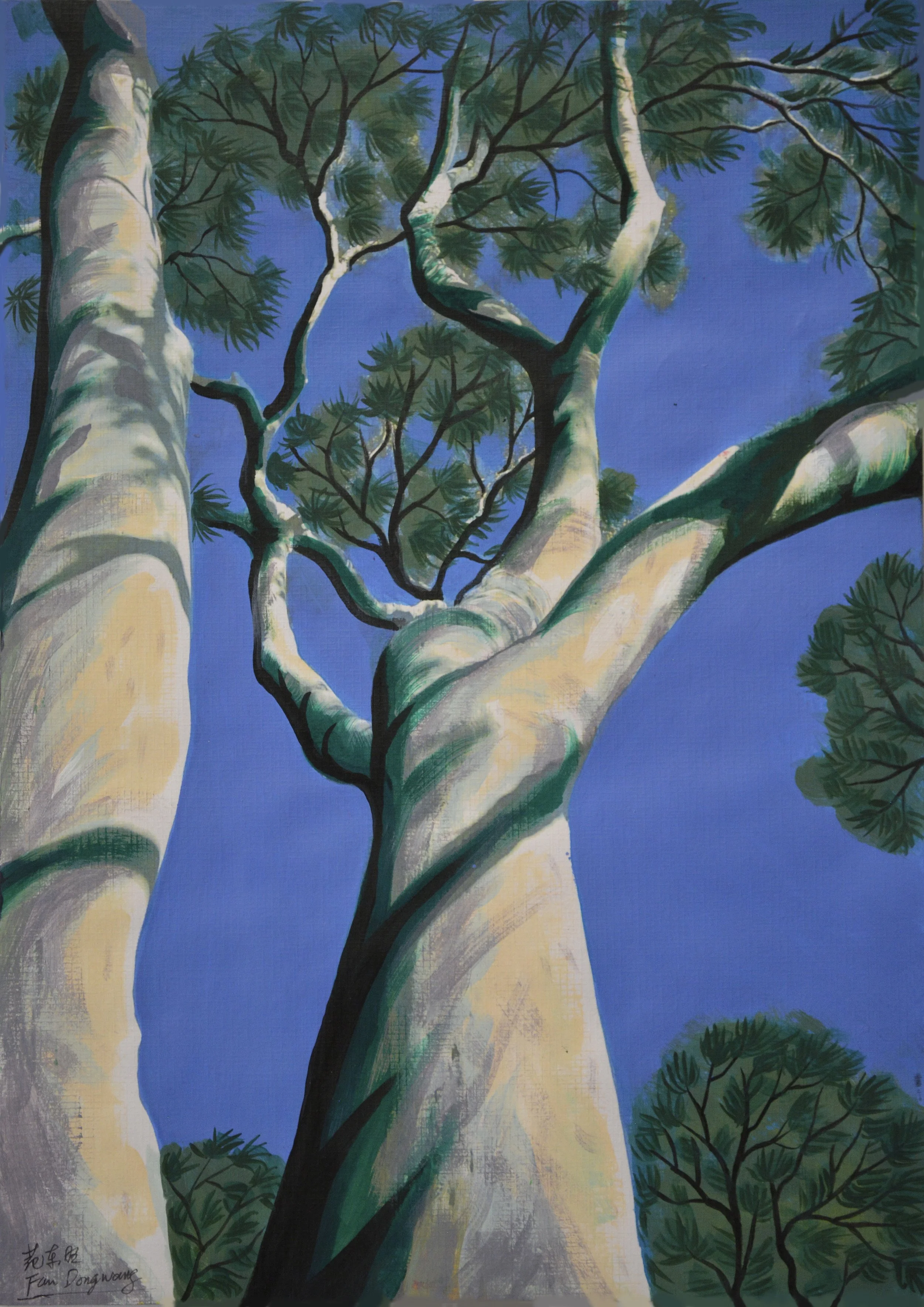
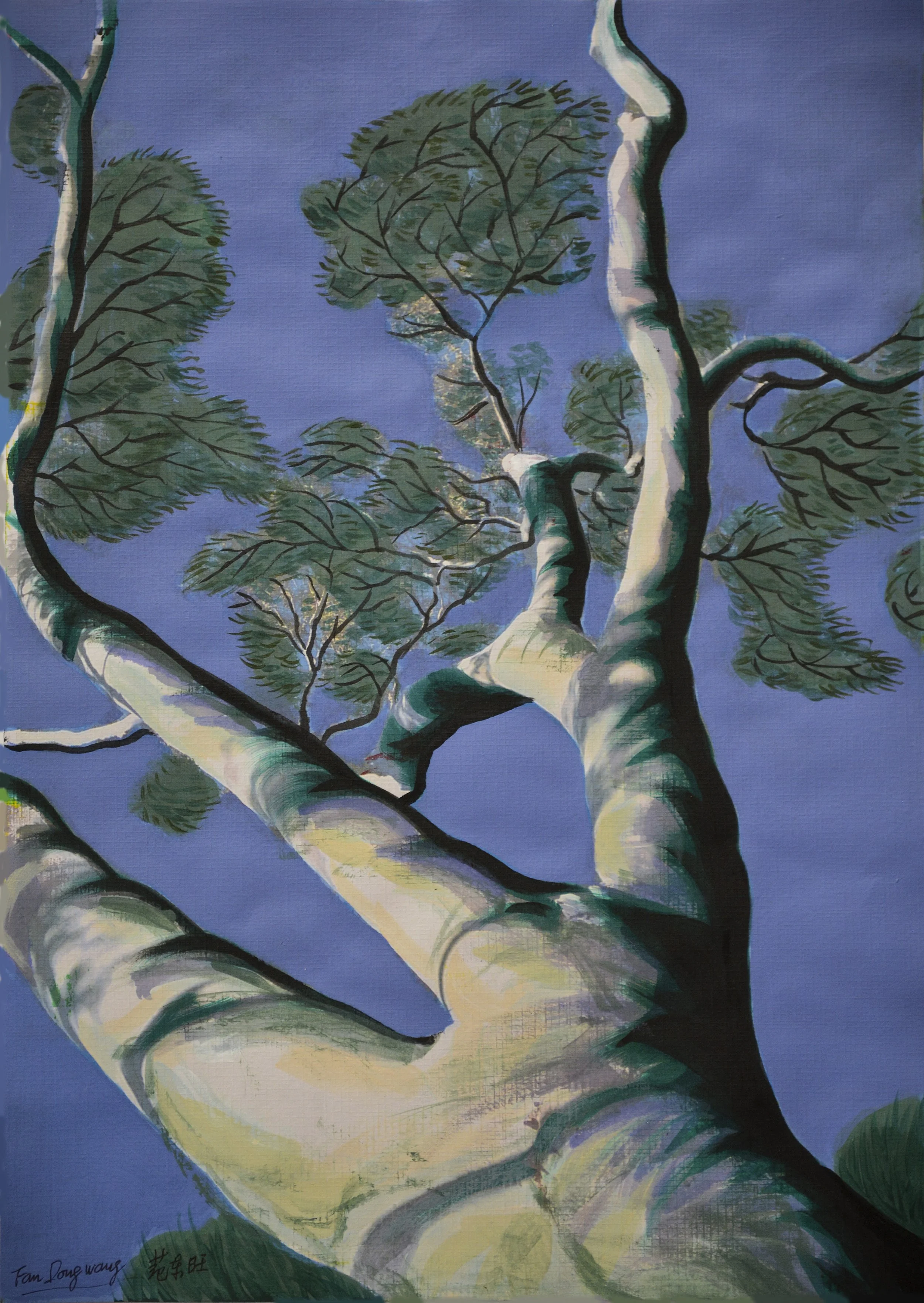
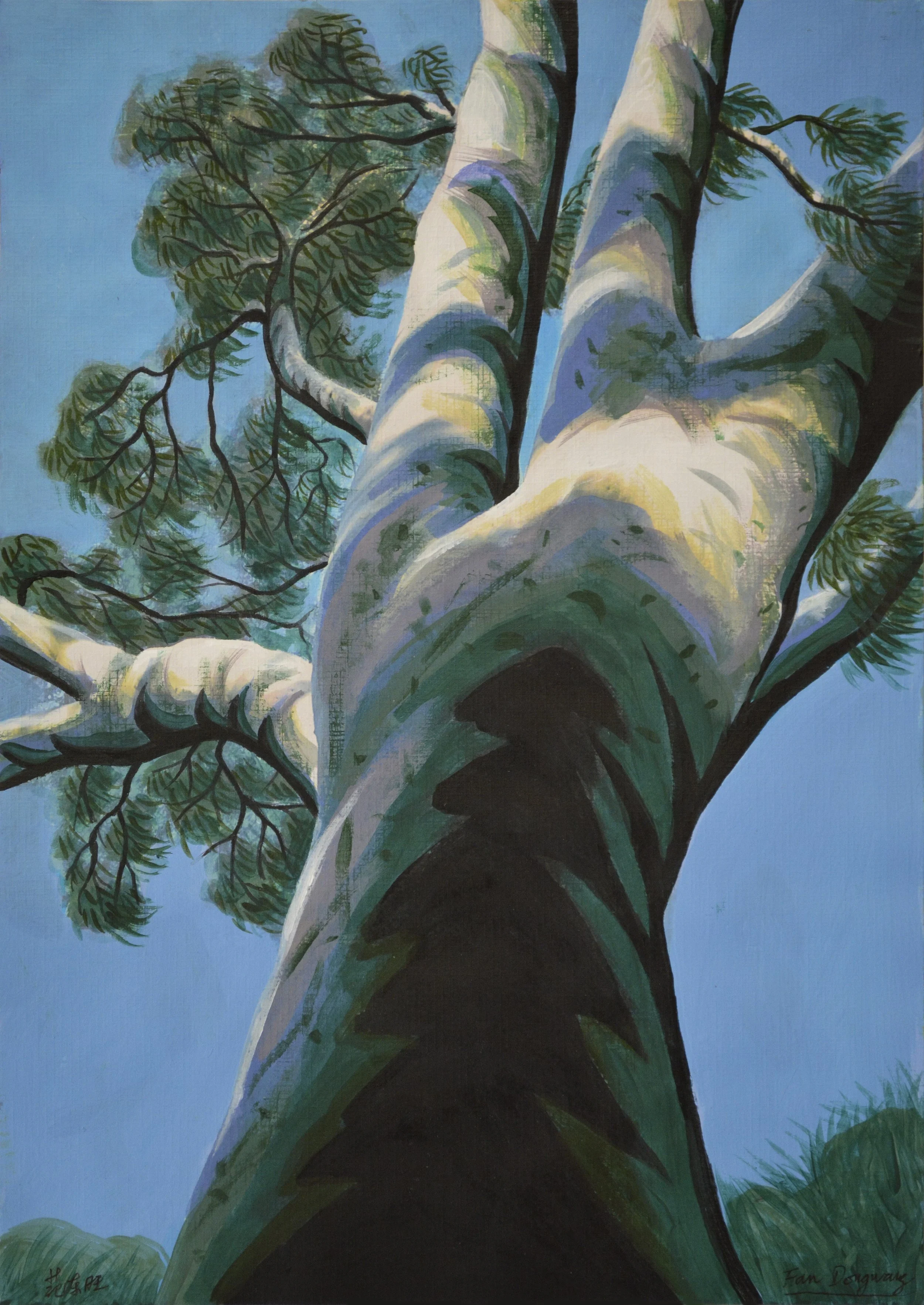

Acrylic on canvas
80 x 98 cm